The Hidden Infrastructure Tax of Running Autonomous Agents 24/7
The Good Tech Companies · 2026-08-21 · 12 min
Show full episode description
This story was originally published on HackerNoon at: https://hackernoon.com/the-hidden-infrastructure-tax-of-running-autonomous-agents-247 . Learn how to run autonomous AI agents reliably 24/7 by comparing laptops, unmanaged VPSs, and managed runtimes, with a practical look at agent infrastructure. Check more stories related to undefined at: https://hackernoon.com/c/undefined . You can also check exclusive content about #autonomous-agents , #deploy-your-managed-ai-agent , #openclaw-agent-deployment , #cloudways , #agentops , #agent-deployment-on-cloudways , #good-company , #hermes-agent , and more. This story was written by: @cloudways . Learn more about this writer by checking @cloudways's about page, and for more stories, please visit hackernoon.com . Running autonomous AI agents 24/7 requires more than a working model and framework—it requires reliable infrastructure. This guide breaks down the four layers of the AgentOps stack and compares laptops, unmanaged VPSs, and managed runtimes for continuous agent hosting.
✨ Episode Outline — click any point to jump to it in the episode
Problem solved
Agents that work in a terminal demo fail silently when run unattended 24/7 because builders skip the infrastructure layer.
Benefits
- Four-layer agent ops stack (model, framework, observability, infrastructure) clarifies where failures originate
- Managed runtime removes SSH hardening, systemd, firewall, SSL setup taking a day+ on a bare VPS
- Dedicated isolated instance keeps a misbehaving agent away from personal SSH keys and files
- Restore checkpoints roll back agent data and configuration, not just the server disk image
- LLM API keys stay yours — provider billing is not marked up by the host
Use cases
- Deploying OpenClaw or Hermes on Cloudways managed AI agents in ~10-15 minutes end-to-end
- Sizing instances from 1 vCPU/2GB RAM up to 8 vCPU/16GB RAM per agent workload
- Monitoring tool-call failure rates and latency creep to catch context bloat early
- Using promo code HACKERNOON for $5 in Cloudways credits to try agent hosting
KPIs / results
- Bare VPS setup: 1-2 hours if nothing goes wrong; managed runtime: minutes
- Real deployment time ~10-15 minutes vs marketing's 5-minute promise
- Instance tiers from 1 vCPU/2GB RAM to 16GB RAM
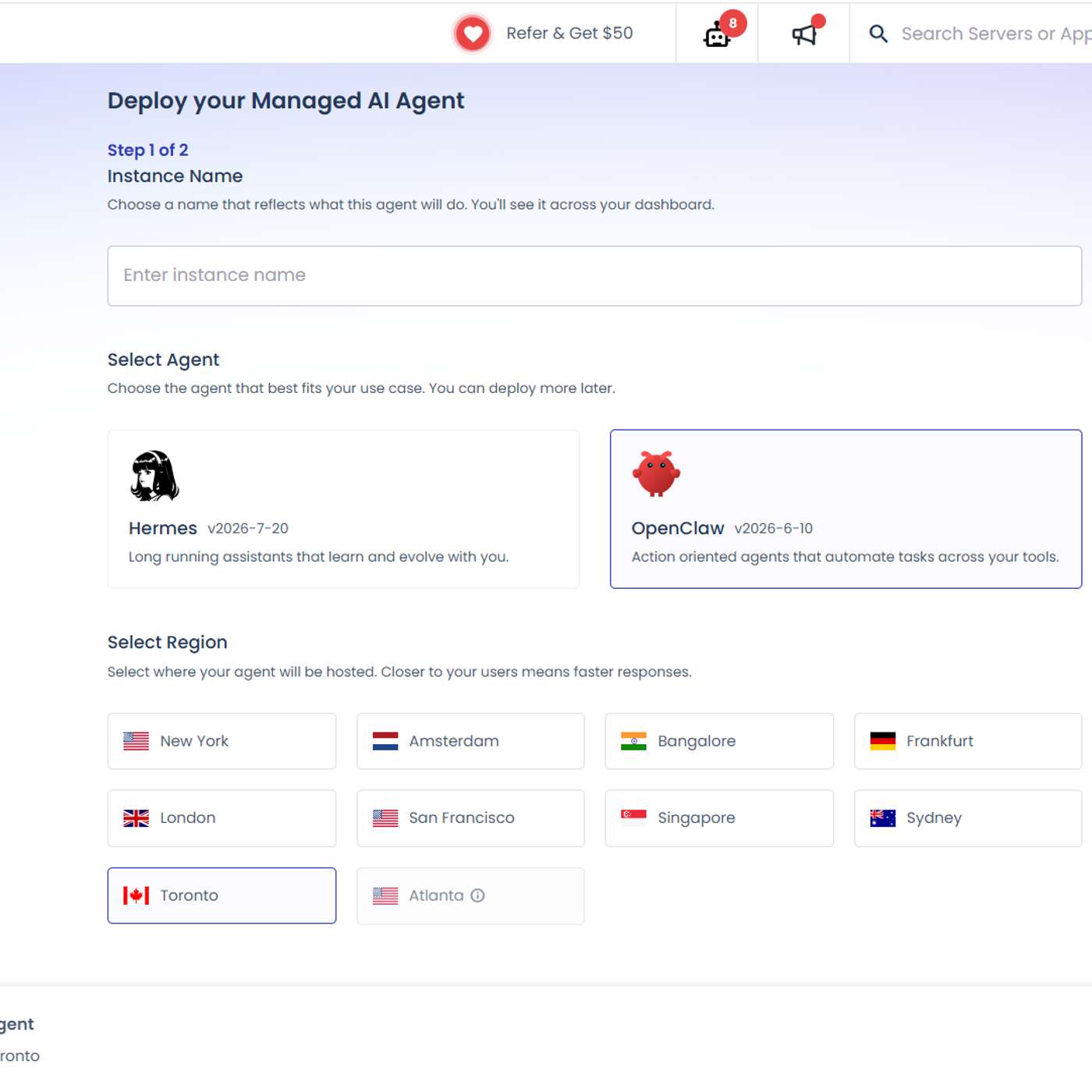
This audio is presented by HackerNoon, where anyone can learn anything about any technology. The Hidden Infrastructure Tax of Running Autonomous Agents 24/7, by Cloudways by DigitalOcean. Picture the moment every agent builder eventually hits. You've got a script working. It reads a task queue, calls an LLM, executes a few tool calls, writes some output, and loops. In a terminal window, on your laptop, it looks like magic. So you do the obvious thing, you let it keep running. You close the terminal tab but leave the process alive. By morning, one of three things has happened. The laptop went to sleep and the loop died silently three hours in, and you have no idea what state it left things in. Or it kept running, burned through a significant chunk of your API budget on a task it got stuck in a retry loop on, and nobody noticed until the bill showed up. Or, in the worst version of this story, the agent had shell and file access to the same machine that holds your SSH keys in your browser sessions, and something in its tool calling went sideways. Unfortunately, none of this is a hypothetical edge case. A demo that runs 14 minutes while you watch it is a completely different piece of software ton a process meant to run unattended for weeks. The gap between those two things is not a few extra lines of code. It's an entire missing layer, infrastructure. The agent ops stack in four layers. It helps to separate what an agent needs into layers, similar to how observability platforms like Lang Smith and Arise already break down the agent lifecycle for debugging and evaluation. For simplicity, here's a four-layer stack for running autonomous agents. Mode the LLM that is doing the reasoning for the agent. This is the most publicly discussed layer, with debate centered on model competencies and context windows. It's the layer with the most attention and the least differentiation, since most frameworks can swap models with a config change. Framework the orchestration logic that turns a single LLM call into a loop that can act, usually known as the React loop. This is the layer where core agent capabilities, specifically, tool calling, memory across steps, planning, and the mechanism that feeds one tool calls output back in as input to the next decision, reside. This is also where retries an error handling live in matters in agent operations. A framework that silently tolerates a failed tool call and keeps going, or that retries the same failing call in a tight loop, will burn tokens four hours before anyone notices, which is exactly the kind of problem the next layer is supposed to catch. Observability this layer is critical to an agent's operations. It ensures that you can see what the agent actually did in concrete terms, such as token spend per hour, which tool calls failed and how often, how response latency drifts as a session runs longer, and whether the agent's own memory or context is growing in a way that degrades its output over time. Without this layer, the failure mode is always the same. You find out something broke because a human noticed the output was wrong or the bill was high, not because a system component told you at the time. Infrastructure this covers power and network stability, disk persistence for whatever the agent is written to memory, process supervision so a crashed loop actually restarts instead of just stopping, and recovery if the underlying server itself goes down. The critical thing to remember is that a model or framework problem shows up in your output or your logs almost immediately. On the other hand, an infrastructure problem is the one that fails silently, sometimes for days, because nothing about a dead process looks different and you can't go looking for the why behind the failure. Of the four, infrastructure is the one that gets skipped most often, and it is the one that fails silently. A bad prompt shows up in your output immediately. A bad orchestration pattern shows up in your logs. A bad infrastructure choice shows up three weeks later, when the process has quietly not been running since a laptop update forced a restart. The amount of work and time you need to put in the infrastructure layer is a significant part of the hassles of running autonomous agents. Now that you have a clear idea of the four layers, let's look closer at the infrastructure layer. Laptop, unmanaged VPS, or managed runtime. There are really three options once you decide an agent needs to run continuously, and each one trades away something different. Your laptop this option has zero uptime guarantees, full exposure of your personnel environment, and battery or sleep settings that will eventually kill your process without asking. The uptime problem alone rules this out for anything you actually depend on. The security problem is the more serious one, as an agent with shell and file access on your primary machine can reach the same passwords, sessions, and documents you can, because it's running with basically the same permissions as you. If a bad tool call, a bad memory write, or a prompt injection ever pushes the agent somewhere it shouldn't go, there's no boundary stopping it. The unmanaged VPS you get a real always on box, but you now own everything on top of it. In practice that means SSH hardening and key management, system d unit files, Sothe process restarts on crash and on reboot, firewall rules, SSL certificate provisioning and renewal, and some kind of monitoring so you find out about failures before your users do. None of that is agent logic. It's the same DevOps checklist you'd need for on your ways on service, and it routinely eats a full day before you write a single line of the thing you actually wanted to build. Plenty of teams still choose this path deliberately, because full control over the box is worth the setup tax to them, especially once they're operating at a scale where the economics of a bare server beat a managed markup. The managed runtime this middle path between your personal laptop and an unmanaged VPS, our bare metal box, offers a dedicated, isolated server for the agent. More specifically, the provisioning, patching, and backup work is handled for you, while you still keep terminal access when you need to get under the hood. Here's how those three stack up against each other on the things that actually matter for a 24-7 agent. Laptop bare VPS managed agent hosting set uptime minutes, but unreliable 1-2 hours if nothing goes wrong minutes uptime sleeps, reboots, network drops solid once configured solid, built for continuous processes isolation from your personal files none full, but you configure it full, dedicated instance per agent terminal access yes yes yes rollback if something breaks none d snapshotting built in restore process with checkpoints ongoing DevOps work none, but nothing else is handled either all of it, indefinitely handled by the provider note that none of this makes a managed runtime the automatic right answer. If your workload is genuinely bursty and short-lived, a sandboxing platform built for that pattern, such as E2B, will probably cost less and fit better thanpaying for a dedicated always-on instance. And if you're running at a scale where the per-instance markup of any managed platform adds up to real money, a team with the DevOps capacity to run its own fleet will usually come out ahead on raw cost, even after accounting for the engineering time. Remember that managed runtime offers the best of both worlds in terms of access and taking the DevOps workload off your plate. What a managed runtime actually handles? Cloudways added a managed hosting product specifically for this problem. It currently supports OpenClaw, an open source agent you fully control and extend, and Hermes, built around a self-learning and self-improving loop. Both run on the same underlying managed infrastructure, so the choice between them is about which agent framework fits your use case, not which one gets better infrastructure. Setup, without the DevOps checklist, you pick an agent, choose a data center region and an instance tier, connect your own LLM API key from a provider like OpenAI, Anthropic, or Google, and the instance provisions. Instance tiers currently run from a smaller option, 1vcpu, 2GB RAM, up to a larger 1.8vcpu, 16GB RAM. So you can size the box to the workload instead of guessing at a one-size-fits-all VPS spec. Isolation that works in real world, the agent gets a dedicated instance, separate from your laptop, your personal files, and every other customer's environment. If a bad tool call or a compromised skill causes trouble, the blast radius is the agent's own sandboxed workspace, not your passwords and documents. A rollback that covers more than just the disk. The term, rollback, can mean very different things depending on the platform. A restore checkpoint here brings back the agent's data and its configuration, not just the underlying server image. A bare VPS snapshot usually only restores the file system and says nothing about what state the agent's memory or vector store was left in. It is important to know what counts as agent data for your specific framework. A self-written skill or an outside vector database might sit outside the system's backup checkpoint, and thus may not be available for a store. While this is not an infrastructure failure, it's still a real loss for whatever the agent had stored. Your keys stay yours. Usually, LLM API costs are billed by your provider directly, not bundled or marked up in your agent hosting platform. So, if you're already paying OpenAI or Anthropic for LLM usage, that spend doesn't change by moving the agents home. Here's what deploying an agent on a managed runtime actually looks like. Using Cloudways managed AI agents as the example. The steps below apply, with minor differences, to most managed agent runtime providers. Walking through an actual agent deployment on Cloudways managed AI agents. Here's what the process looks like end-to-end on Cloudways managed AI agents' platform. Total time, done carefully rather than rushed, lands closer to 10 to 15 minutes than the 5 minutes. A marketing page might promise, mostly because instant specification selection, step number 3, is worth double-checking rather than racing through, and because server provisioning itself takes a few minutes. Once the agent has been deployed and you see the interface, your agent is alive, but not very useful. You need to connect your communication channels and MCP servers for whatever platforms you want your agent to access. This is also a good time to configure the agent's personality and provide it with context about you and your operational expectations. If you want to try the agent launch process yourself and see how Cloudways managed AI agents remove the infrastructure layer hassles, we have a special treat for you. Use the promo code H-A-C-K-E-R-N-O-O-N while signing up to get $5 in Cloudways credits. While the agent has been running for some time, it is also a good idea to keep an eye on tool call failure rates if the agent is hitting external APIs, and note whether response latency creeps up as a session runs longer. Any upward tick in the latency figures is often the first sign that something in memory or context handling is degrading. In that case, check the context the agent is passing to the LLM to identify context bloat. A short checklist, regardless of what hosting infrastructure you pick. Whichever of the three paths you land on, the same questions apply. Does it need to survive a laptop sleeping, a network dropping, or a reboot, without you finding out by accident? If the agent's memory or self-written code degrades its own performance, can you get back to a known good state without doing it by hand? Is the agent isolated from your personal files and credentials, or does a bad tool call have a path to everything you can reach? At the scale you actually expect to run it, does the DevOps time you'd spend on a bare VPS cost more than the markup on a managed option, or less? There's no universally correct answer to that last question, and that's the honest takeaway here. A managed runtime like Cloudways managed AI agents removes a specific, real cost. The day or more you'd otherwise spend on SSH hardening, system D units, and certificate renewal before you get to write any agent logic at all, plus the ongoing patching you'd owe indefinitely afterward. What it doesn't remove is the need to actually watch what your agent is doing once IDs live. Infrastructure that survives a reboot and needs no upkeep from you still want to stop an agent from misbehaving if nobody's watching what it does. You should keep a close eye on agent operations so that you can anticipate and mitigate context drift and retry storms. Greater than if there is one idea you should take away from this article, it is this. Get greater than the infrastructure layer out of the way, because agent operations are what greater than actually require your full attention. Thank you for listening to this HackerNoon story, read by artificial intelligence. Visit hackernoon.com to read, write, learn and publish.