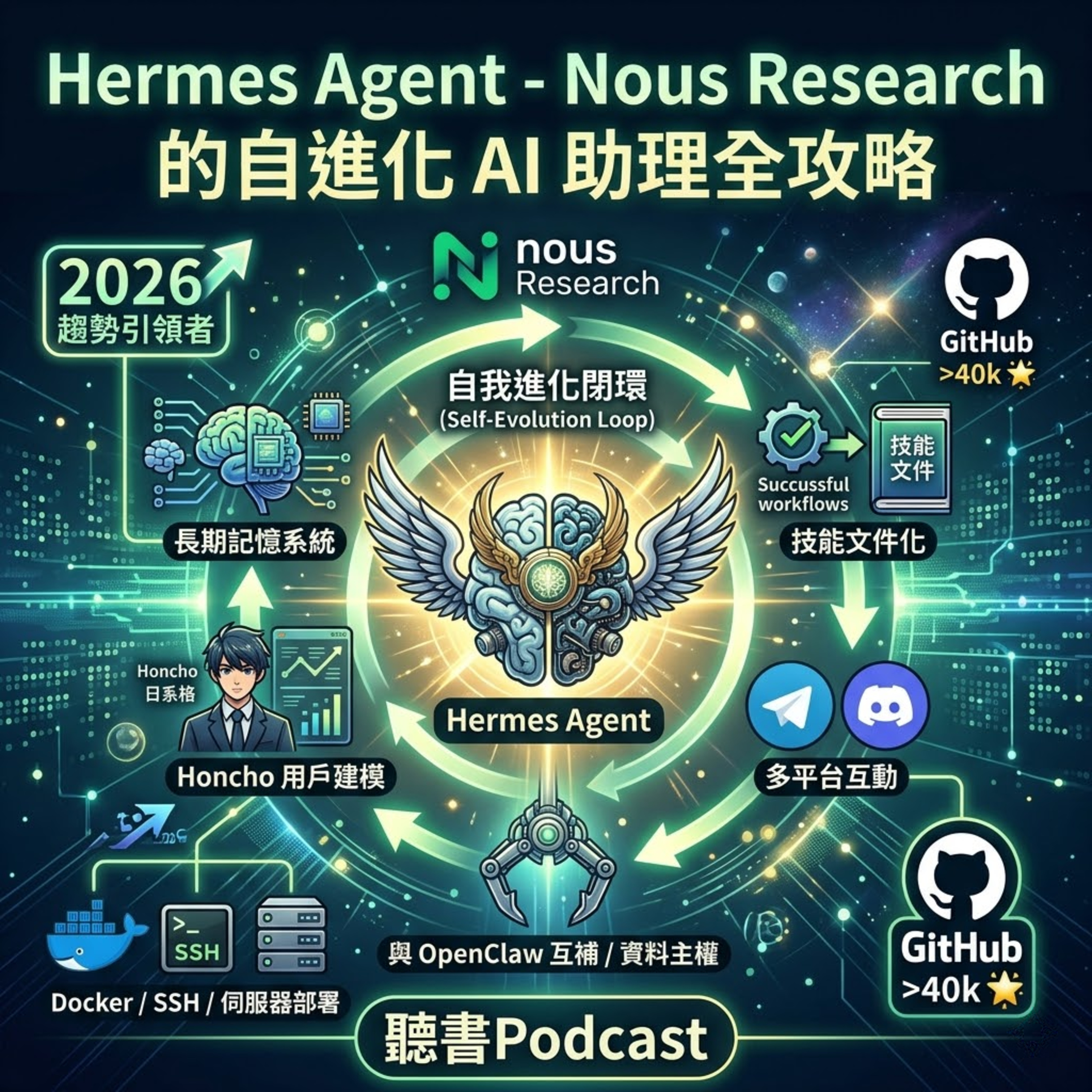
Hermes Agent-Nous Research Self-transformation AI technology and technology
聽書-科技X成長 · 2026-04-15 · 21 min
Show full episode description
EP. 326 | Hermes Agent 全攻略:AI 終於學會「自我進化」了?打造越用越懂你的專屬開源大腦! 🧠⚡ 每次交代 AI 做事,是不是都覺得像在教新人,隔天它又把你的偏好忘得一乾二淨?這集我們要為你開箱 2026 年 GitHub 上狂飆超過四萬顆星的現象級專案——由 Nous Research 開發的「Hermes Agent」!它徹底打破了傳統機器人單次對話的限制,為我們揭開了「自進化 AI」的全新時代! 🎯 本集精彩亮點 🧬 寫入基因的自我進化 教過一次,它就自己寫成 SOP!探討 Hermes Agent 最核心的「學習閉環」,看它如何將成功的工作流程自動轉化為可重複使用的「技能文件」,實現真正的自我升級。 🧠 擺脫金魚腦的超強記憶 內建強大的長期記憶系統與「Honcho 用戶建模」技術。它會默默觀察、累積經驗,變成一個越用越順手、完全客製化的超級數位分身。 🌐 無所不在的全平台部署 無論你是想在 Telegram、Discord 上隨時呼叫它,還是透過 Docker、SSH 部署在自己的伺服器上,Hermes Agent 都能完美融入你現有的工作流。 🛡️ 資料主權與 OpenClaw 生態系 你的 AI,你的資料!解析它與 OpenClaw 架構的完美互補,不僅提供一鍵遷移的便利,更把隱私與資料主權牢牢交還到使用者手上,向科技巨頭的綁架說不。 💡 聽完這集想告訴你: 未來的 AI 戰場,比的不再只是誰的模型更大,而是誰的代理(Agent)更具備「適應力」與「進化力」。掌握 Hermes Agent 的底層邏輯,你不僅是擁有了一個不知疲倦的超級助理,更是拿到了一張通往未來自動化生產力的頭等艙機票! 節目收聽: Spotify / Apple Podcast / YouTube Podcast #聽書Podcast #HermesAgent #NousResearch #人工智慧 #AIAgent #自我進化 #開源專案 #機器學習 #生產力工具 #工作流自動化 #開發者 #資料隱私
✨ Episode Outline — click any point to jump to it in the episode
Problem solved
Deep dive into how Nous Research's Hermes Agent gives AI persistent memory and self-evolution versus stateless agents.
Benefits
- Three-layer memory solves AI amnesia
- FTS-5 plus LLM semantic retrieval, not literal keywords
- Auto-writes successful experiences into Markdown SOP skills
- Honcho dialectical user modeling adapts to your style
- Serverless deployment cuts idle costs to near zero
Use cases
- GitHub stars soared past 47,000 in under two months since release
- V0.8.0 and V0.9.0 (April) triggered large-scale migration from OpenClaw
- Five-step learning loop turns a 30-minute bug fix into a reusable Markdown skill
- Supports six backend deployments (Docker, Modal, Datana) and 15+ platforms (Telegram, Discord, Slack, WhatsApp)
- OAuth integration runs the agent on existing Cloud Pro/Max subscriptions to bypass pay-per-use API
KPIs / results
- 47,000+ GitHub stars in under two months
- Three-layer memory system; five-step learning cycle
- Six deployment backends; 15+ communication platforms
🌐 This transcript was automatically translated to English from the original.
Welcome to collect money and listen to books - the Podcast channel is produced by a vegetable engineer. Well, imagine that the AI assistant you use every day is not just helping you write code or replying to letters. Yes, he is actually staring at you silently. Yes, he is secretly observing every one of your work habits and then directly packages your unique problem-solving logic into a digital file. It is even said that all of this may be preparing for a super large decentralized network. Does it sound like the beginning of some cyberpunk novel? Really, but this is the technological change that is happening in the open source community now. Indeed, we are actually witnessing the transformation of AI from a relatively passive question and answer machine to a digital entity that really has memory and can evolve on its own. So this is the protagonist we will take you to analyze in depth today. This open source AI agent framework developed by NOS Research is called Hermes Agent. Yes, this project has become really popular recently. This time, we combed through Github There are official technical documents on the website and in-depth discussions on many developer forums. In addition, the latest reports of these technology media such as 36kla. It has only been released for less than two months and the number of emerging units on Github has soared past 47,000. It is really exaggerated. What is even more indicative is that the V0.8.0 and V0.9.0 versions they released in April directly triggered a wave of large-scale relocation. Where did the large-scale relocation come from? It is from the benchmark project Open Claw that currently dominates the market. Many developers have decided to switch jobs and use Hermes. You know, in the open source world, you have to let the engineer put away a whole set of workflows he has already developed and switch to a brand new framework. The conversion cost is very high. Yes, this usually means that this new tool really solves a fundamental problem that makes everyone miserable. OK, let's unpack this. This problem that makes everyone miserable is actually AI amnesia. Yes, the whale brain of AI. Most of the Agents on the market today are stateless, that is, as soon as the Stateless task is over, well, his head is cleared instantly. You have to tell him the background again every time and redefine your city code style. It is super annoying and will really make people crash when using it. Hermes claims to have built a set of memories that can span time. How does it do it? In fact, the most fascinating thing here is that What's festivating here is that it does not just rely on a single database. It has established a very three-dimensional three-layer memory system. Three layers, which sounds very complicated. The first layer is cross-session memory. It uses an engine called FTS-5 and then it is paired with the important technology of large-scale language models. Wait a minute, what is FTS-5? FTS-5 is actually an expansion module in the SQ-Lite database specifically designed for extremely fast full-text retrieval. So it is like a Google search engine built directly into the AI's head? Well, it can be understood that way, but it is actually a little smarter than that. How to say? Because if there is only FTS-5, it can only do a rigid version of keyword comparison. But Hermes will throw the historical records retrieved by FTS-5 to LLM for contextual semantic analysis. In other words, if I tell it, it will also help me handle the database error reported last Tuesday. Yes, it can accurately correlate to the context of your conversation last Tuesday. It will know which database you are talking about and which link you were stuck at at that time. Wow, this really completely solves the pain point. What about the second and third layers? The second layer is called Skill Documents. Skill Documents will directly convert your previous successful experiences into Markdown files and then store them in the local folder of your computer. It is quite safe to store them locally. Yes, the third layer is also life-enhancing. It is called Honcho Dialectical User Modeling. The name sounds very hard-core. Simply put, it will dynamically depict who you are every time it interacts with you. Do you want to study me? Yes, it will secretly record whether you have a high tolerance for errors, or whether you prefer to write the architecture first, or whether you like to revise as you write. It will even record your tone preference when communicating. Wow, so it is not only solving the problem at hand, it is also studying me. This reminds me of a metaphor. Traditional AI is like a super intern with only a goldfish level of memory. It has to be retaught every time. Yes, every time you hand over a task, you have to smash the thick employee handbook to it. But what about Hermes? It is more like a new colleague who will write down his successful experiences as SOP notes after completing the task. This metaphor is quite accurate. Next time he encounters a similar problem, he can just read his own notes. But, wait a minute, how does it turn the bunch of chaotic conversations in our terminal into a structured SOP? It can't be retraining its underlying Shenjun Network. Oh, you pointed out a very key technical detail. It is definitely not modifying the weight of the large model. The computing power cost is terrible. Our ordinary computer can't run at all, so how does it do it? In the Hermes system, this is set up as a five-step learning cycle, that is, observation, extraction, skill building, refinement, and finally push. What exactly does this look like at the level of program code? Imagine it. You may have just spent about half an hour asking AI to help you solve a very tricky shooting bug. Usually the terminal screen has long been washed out by various error reports. Yes, it is full of various failed attempts and invalid instructions. This is actually the first step. That is to observe, and then enter the second step of extraction. Hermes will secretly start a relatively small summary model in the background, such as MiniMax M2.7. It will review the entire chaotic Log Ridge you just went through. Oh, so it is equivalent to sending another small AI to act as a referee to find out which step in the half hour is the key to solving the problem. That's it. It will extract the Python command that finally succeeded and the previous environment settings, and then enter the third step. Write it into a Markdown file that complies with open standards. This file is actually a high-density prompt word, right? That's right. If it encounters the same situation next time, it will read this Markdown and skip the previous half-hour of fuss. Then the subsequent experience and push will be that it optimizes these notes by itself when your computer is idle and turns the notes into a more general long-term memory. Right, solidify it, but this brings up a problem that I think is quite fatal. If it keeps writing its own rules based on seemingly successful experiences, how do we control it? This is why the developer community is now divided into two factions. Everyone is comparing Hermes with the very popular OpenCloud at the beginning of the year. In fact, the two represent completely opposite AI philosophies. This is a duel of evolutionary adaptation. Is the philosophy of absolute control colliding? It can be said that the core concept of OpenCloud is a high degree of certainty. Its capability boundaries are all pre-written by human developers. It is a password and an action. It relies on traditional RAG tools, that is, subtractive enhancement generation. Humans first prepare the knowledge base. When AI encounters a problem, it goes inside to find the answer and then executes it very accurately. It sounds like OpenCloud is working in a highly regulated factory without cities. Every action must fully comply with the specifications. Yes, so it is very suitable for enterprise-level tasks with extremely low fault tolerance. But Hermes takes the emergent route. Emergent means that skills are grown by themselves. Yes, they are born from countless practical experiences. But won't this cause serious overfitting? Overfitting I am in Hugging I saw a lot of senior engineers warning about this on the Face forum. What did they say? For example, in order to solve a network connection error today, I violently turned off the firewall of the entire server world. As a result, the connection was successful. It really happens very often in reality. Then Hermes Cohen found this result. Will he write in his notes that he will turn off the firewall when encountering network problems in the future? If he regards this accidental and even destructive stupid method as truth. In the long run, won't his head betray the noise? Will he eventually go crazy? Isn't stability more important than this kind of romantic autonomy? Well, this actually brings up a very important question. This is the core trade-off we must face when deploying any autonomous agent. Do you want pre-characteristics or adaptability? You can't have your cake and eat it too. The warning above Hogging Face is very accurate. This kind of noise accumulated in long-term memory is indeed the fatal flaw of the current self-evolving system, as long as it relies on experience learning. There must be a risk of mistakes and experiences being magnified. So does Hermes have any way to solve this bottleneck? We can't always let him write wrong SOPs. Their strategy is actually quite clever. Hermes system has a built-in command called Hermes Claw Migrate Migrate. The meaning of moving is yes. He also said that he does not want to eliminate OpenClaw. He can even painlessly absorb all OpenClaw configuration files with one click. Wow, if you can't beat it, absorb it. That's right. So in the actual engineering structure Now many developers have explored a dual-engine complementary model. How the dual-engine works is to let OpenClaw be responsible for the bottom layer, the kind of precise execution that requires strict permission control, and then let Hermes sit on the upper layer and be responsible for higher-dimensional strategic planning to respond to the vague new needs. Oh, I understand. In other words, use OpenClaw as the chassis and brake, and then use Hermes. Mes is used as a brain navigation system, and the risk of trial and error is controlled in the box. Yes, this architecture is really imaginative, and it's really cool. But when it comes to deployment, this is where it gets really interesting. Here's where it gets really interesting. It breaks the physical limitations we have on AI. How do I say that with traditional AI assistants like the Chat GPT or Github Co-Pilot we are using, you usually have to open a special web page or is it bound to your script? That's right. If you leave it, you can't use it. Yes, the AI falls asleep as soon as my webpage is closed. But Hermes is different. Because traditional AI essentially requires you to connect to other people's servers. But Hermes supports six different mid-end backend deployments. Six types. Yes, it can not only run Docker boxes on your computer, but it even supports Serverless environments like Modo or Datana, that is, serverless environments. What does this mean for Ichiban Tingzou? It means that the Agent is waiting for your instructions. When it is not doing any calculations, it is in a hibernating state, so you don’t have to spend money. There is almost no need to pay for the idle time of the server. But as soon as you issue a command, it will wake up instantly. Wow, this serverless design has really completely changed our personal cost structure for deploying powerful AI. Not only that, it also has a built-in multi-platform gateway. You can use only one command to seamlessly connect it to your Telegram, Discord, Slack, and even 15 communication platforms such as WhatsApp. This is the most sci-fi part. In this way, it is no longer just a gadget that is locked in my computer screen. It directly becomes a big butler in the cloud. Yes, you can call it at any time. I can walk on the road and send a voice to it using Telegram. Help me check the LOG record of the remote server last night. Fix the error. By the way, send me a briefing. Then it will wake up in the remote serverless environment and silently help you get all this done. Oh my god, but what about the cost? In practice, it would be crazy to have an autonomous agent continuously observe and extract in the background and call the language model. It would be crazy to burn API tokens. I may not be able to pay the bill. Oh, this is where the News Research team is very smart. They provide a very strategic function. What function? Hermes supports direct integration of your existing Cloud Pro or Cloud Max subscriptions through the OAuth mechanism. Wait, you mean that it can directly use my monthly subscription quota to run. That’s right. It is equivalent to letting the Agent directly apply the fixed amount you have paid, which perfectly bypasses the super expensive pay-per-use developer API model. Wow, this is definitely a huge game changer for heavy users. It saves everyone a lot of money. But oh, when we put this extremely smart and ubiquitous AI that can directly control the terminal directly to the cloud, the security mechanism will become very scary. I will indeed be a little worried if he wants to fix a small bug today. Suddenly decided to issue an order to delete my entire database. What should I do? Don’t worry too much about this. Hermes has introduced a smart authorization mechanism similar to Codex. Smart Approvals means humans must intervene, right, that is, humans in the loop. When Hermes’ scolding actions include destructive instructions, such as changing system permissions, deleting blocks, etc., yes, the system will be forced to pause, and then it will ask you for the order through Telegram or Slack that you have bound. Is it okay to say that I am ready to execute this command? He will only continue to run when you click Agree. What if he has gone crazy and the entire logic collapses? You can type Stop in the chat room at any time and he will forcibly cut off all processes. Okay, this sounds much safer. What about privacy? He keeps extracting my logs into notes, which must accidentally contain my API medicine or customer confidential information. They have also thought of this. He has built-in mandatory PII, which is a coding mechanism for personally identifiable information. There is also confidentiality masking for gold medicine, so it is processed before uploading to the big model. Right, before sending the logs to LOM, he will replace all these sensitive strings on your local side. Even if he needs to crawl data on the Internet, he also supports anti-detection browsers like Camel Fox to ensure that he will not be easily tracked when he automatically surfs the Internet. Wow, the protection is very thorough. So what does this all mean? We just talked about how powerful its technology is, how flexible its deployment is, and it has saved us a lot of money. But to build such a perfect open connection technology machine, are they really doing charity? This is very deep. Right. When we dig into the background of this development company NOS Research, things become very intriguing because this company has a very strong Web3, which is the gene of decentralized blockchain. Yes, this is indeed another dimension that cannot be ignored in understanding the Hermes project. Their boss is also a person in the currency circle. Their CEO Jeffrey Quesnell He was previously the chief engineer of the Ethereum infrastructure Eden Network, and they recently received a financing of up to US$70 million. US$70 million? There is another important point. This financing is not a new equity financing like traditional Silicon Valley. It is priced using tokens. No wonder this immediately triggered a huge controversy in the community. I see that an unofficial token called NOS has appeared in the cryptocurrency market. And countless people have begun to expect in the community that the official will issue short-seller rewards in the future, which is to record short positions. What’s more important is that when you spread out the bottom layer of Hermes, look at it. Has it been encouraging you to hang up and run locally for a long time and continue to accumulate your success track in solving problems? Yes, and there is a name in the system that we didn't mention just now. It says that it supports exporting the training data of Atropos RL. Can you explain to our audience what this is? No problem. This RL stands for Reinforcement Learning. So Atropos is actually a framework used to collect human preference data. Collect human preferences? In other words, Hermes does not just write down your habits as notes for himself to read. It can also package your programming habits and trial-and-error logic into a standard data format that can be directly used to train larger AI models in the future. Well...this is where I think the most impressive thing is. Is this the perfect fit with Web3's logic of contributing data to prove the workload? Proof of Work does have this flavor. As an ordinary engineer who just wants to use AI to improve efficiency, I am very confused now. Should I treat it as an open source tool that single-handedly improves productivity? Or should I realize that when I am happily enjoying this free butler over there, you have actually become a miner working for others, right? Have I unknowingly become a free worker in a huge network, helping to produce high-quality training data? If we connect this to the bigger picture, we actually have to calm down and separate the practical value of technology from the operating logic of capital. Will this help Glass? Aren’t the two tied together? In this open source system, it can actually be separated. For developers, Hermes is undoubtedly the most beautiful architecture and the most thorough agent system that implements closed-loop learning. Well, technically it is really strong. And because its code is open source, this means that you can completely cut off its external network and only run it in your local sand river. You can not export any Atropos RL data or pass it to anyone. The mechanism of the tool itself is reasonable. But what about the crazy hype of those webster capitals? Or those farming articles on the Internet that teach you how to hang up Hermes to earn rewards. You must be extremely cautious, just don't get cut. That's right, because the official has not clearly announced any reward mechanism. When we play with new technology, the focus should be on whether the memory mechanism of this set of tools can bring substantial negative effects to your personal work. This is the value that you can really hold in your hands. This is really very important. We should arm ourselves with tools instead of turning ourselves into data sources in capital stories. Okay. Let’s summarize today’s in-depth analysis. We are actually experiencing a paradigm shift in AI capabilities. Yes, in the past, we all paid monthly to OpenAI or Anthoropic to rent a standardized smart brain. But Hermes Agent showed us one thing. AI is transforming into a personal digital asset that we can truly own and keep in our own hard drives to accompany us. He has redefined the dimensions by which we evaluate AI. The focus is no longer on how smart it is on the first day it is unboxed, but after it has been fighting side by side with you for half a year and a year. How well can he understand you? So at the end of the show, I want to leave you with a thought-provoking question. Imagine that in the next year, through constant observation and extraction, your Hermes Agent will perfectly copy your circuit of thinking about problems. Your unique naming habit when writing about cities. He may even know better than you yourself about the logical blind spots you are most likely to make when working. Really, by that time, he is no longer just a tool, but a highly customized version of you. Then the problem comes when one day you decide to buy a new computer. Or maybe there is a new and awesome new framework on the market. When you are ready to back up and transfer, the folder of DOT Hermes Skills is right. The folder loaded with all your behavior patterns this year. This file may only be a few MB in size. Is it still a pure software asset? Or has it actually become an extension of your personal mind in the digital world? When we finally cured the amnesia of AI, did we also inadvertently create a digital clone with fragments of our souls? I’ll leave this question to you to explore slowly by yourself. Thank you for listening. Welcome to subscribe to the Share Listening Book Podcast channel. See you next time.