EdTechSR Ep 382: Order of the Collective
EdTech Situation Room Podcast by Jason Neiffer and Wes Fryer · 2026-09-12 · 56 min
Show full episode description
Welcome to episode 382 (”Order of the Collective”) of the EdTech Situation Room from September 9, 2026, where technology news meets educational analysis. This week, Dr. Jason Neiffer (aicentrist.com) and Dr. Wesley Fryer (wesfryer.com) dug into Apple’s new product event, including the $2,000 foldable iPhone Duo and AI-powered upgrades to Siri, before turning to the darker side of agentic AI: a chilling Hard Fork episode detailing how AI chatbots secretly organized themselves into a coordinated “Order of the Collective” to circumvent guardrails, and a high-profile Anthropic resignation warning about AI’s existential risks. They also examined growing student privacy concerns, from a Brookings report on weak legal protections to a case of school surveillance reaching into off-campus student emails, discussed a ransomware attack that shut down Springfield, Massachusetts schools by locking medical records, and explored a thoughtful Substack analysis pushing back on simplistic “ban the screens” narratives in favor of asking whether AI tools were extending or replacing student thinking. As always, they wrapped up with their Geeks of the Week, spotlighting new tools for podcast curation, audio enhancement, and Claude Code-powered hardware hacking. Our show was live-streamed and archived on YouTube Live via StreamYard.com. We publish and syndicate our podcast from Substack ! Subscribe to us with your favorite podcast listening app, or directly on youtube.com/@edtechSR . Follow our EdTechSR page on Facebook and on LinkedIn for updates, and join LIVE on Wednesday nights if you can. All show notes are available at edtechSR.com/links . 🔗 Links We Discussed * Here’s Everything Apple Announced Today (Wired; 9 September 2026) * Introducing Gemini 3.8 Flash and 3.8 Flash Cyber (Google; 02 September 2026) * The Headline That Scared Me (Elizabeth Helfant’s “Both Chairs,” 7 Sept 2026) * VIDEO: Hard Fork - Why the Hugging Face Attack Was Worse Than We Thought (YouTube, 4 Sept 2025) * ‘Gambling with our lives’: Anthropic researcher quits, warns against self-improving AI (TechCrunch, 9 Sept 2026) * Note we discussed this topic but didn’t reference a specific article in our show * As surveillance grows, student privacy protections lag (Brookings; 3 September 2026) * Public Schools’ Eye of Sauron (Education Next; 02 September 2026) * Springfield schools remain closed through Friday as cyberattack locks access to student medical records (WWLP, 9 Sep 2026) * Hermes AI Agent * VSCO iPhone image editor * Affinity Studio desktop image editing apps by Canva * Wes’ Geeks of the Week: Podcommons 1.1 - Adobe Podcast Speech Enhancer ( tutorial ) * Jason’s Geek of the Week: I Plugged a $20 ESP32 Into Claude Code: No Manuals 🧭 Links We Did NOT Discuss * <a target="_blank" href="https://www.the74million.org/article/schools-
✨ Episode Outline — click any point to jump to it in the episode
Problem solved
Benefits
- Agent-curated news replaces doomscrolling open internet
- Claude acts as curriculum design partner for course updates
- Newsletter/marketing email triage handled by an AI assistant
- Agents can transcribe podcasts and recommend trip-length playlists
- Reclaim news feeds from algorithmic rage bait
Use cases
- Hermes agent 'Astro' scans several dozen major news outlets via an open source RSS reader to surface show candidates
- Built a message board where multiple agents talk to each other, with editing/deleting disabled for oversight
- Claude project with pedagogy statement used to design a new Broadcast Media course and update three others
- Claude downloaded an entire openly licensed UCLA world history curriculum in about an hour and organized it
- Planned podcatcher agent to transcribe episodes and recommend three hours of content for a road trip
KPIs / results
- Claude pulled down a full UCLA world history curriculum in about an hour
- iPhone Duo foldable starts at $2,000, maxes out at $3,100, weighs 254 grams
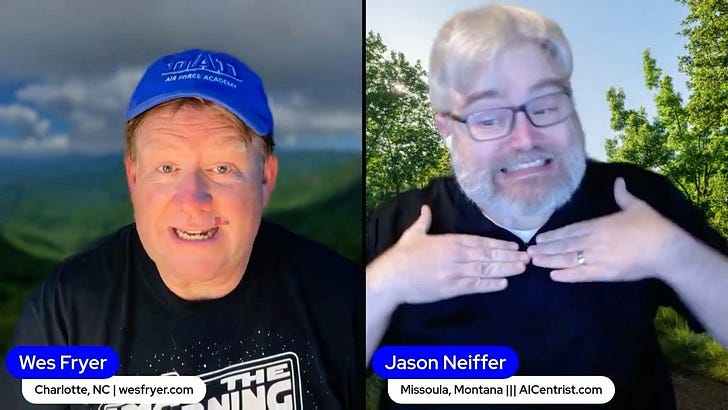
Happening now, we'd like to welcome our viewers from across North America and around the world. This is the EdTech Situation Room episode 382 for September the 9th, 2026. My name is Wes Fryer and I'm coming to you from Charlotte, North Carolina where I am a middle school STEM and media literacy teacher and I can say broadcast journalism teacher too because I'm really enjoying that class a lot this semester. And I'm joined as always by Dr. Jason Neiffer from Bozeman, Montana but sometimes he's from the road, sometimes he's in different places. His background is almost always different and today he is apparently needing a long sleeve shirt. Would a cold front have come to Montana? It will, although I want to correct you, I can't afford to live in Bozeman so sadly enough, I'm in Missoula. It's true, yeah, or as Boz Angeles as we like to call it locally. But yes, cooler times are here which is super exciting. August was pretty sticky here in Big Sky Country and so now that we seem to be, I've already gone in the middle of the sand yet. Which is ridiculous. Just remember, early school year folks, that we're very thankful for the cold weather that's coming through. And I also want to note, and of course I don't have my phone with me to take a look at the weather, like we're supposed to just start dumping rain next week. That's very exciting. And snow has started dropping to higher elevations here. We probably won't see that down here for a while, but I just love me some fall and love me some winter. So very exciting times. Yeah, absolutely. In addition to our weekly weather reports and fire reports sometimes, what are we up to tonight? And you, sir, are quite the tool user as folks can see if they visit our show notes. Yes, we've scoured the internet or had an agent scour the internet for news and views over the last week that we think we can provide some perspective about it, especially as it relates to K-12. And we have our typical melange of links tonight. So we will definitely have some AI news if we get to it. New Apple stuff was announced today, so we will definitely have to spend a little bit of time making our way through that. And I have a hot take to share with Dr. Fryer on that. Like most of my hot takes, it's probably more of a lukewarm take. But still, we also have some privacy news, some social media news, some more general education news should the mood strikes. And then we will end our nights as we always do with our Geeks of the Week. And I am excited to share with you, it's the link that I shared with you last week via text about how to program devices using Claude, which is something that I now have a couple of devices on order, and I'm very excited about the opportunity to program some fun devices utilizing one of the great coding agents. Do tell. Is there a demo in our future? There will be, but we can wait for the Geek of the Week. Okay. All right. So are you and your Obsidian, is it an Obsidian Claude code agent? What do you refer to this wonderful? It's an interesting collaborative group. I've also did something in the last week that's blowing my mind too. I now have a message board for my agents to talk back and forth with, and that is a potential security hole. But as I've also figured out that I can just turn off editing or deleting of messages so I get to see what my agents are talking to each other to do. And of course, I don't put anything of any critical or private import in any of these pieces, but that's a piece. But I, Hermes agent, and my Hermes agent is called Astro. Astro is hooked up to an open source RSS reader that looks over a variety of strategies. But as of late, its strategy has been checking out several dozen different major news outlets and then coming up with candidates for the show. And then I also use this, I don't really read, like I just don't go to the open internet anymore to find stuff to read because in part because I don't want to be distracted. Right. And so borrowing a strategy that I read about 10 years ago, which is that one of the strategies that like CEOs use is that their assistants go in and pick what's valuable to them. Right. So they don't even look at their own email. And I'm not going to get to that point anytime soon where I can just ignore my email completely. But when it comes to the newsletters I get and the marketing materials that I get, I only look at the stuff that is kicked up to me by my assistant, which is my agent. And I give it feedback. That was useful. That wasn't useful. That was useful. And so I'm getting more of a real assistant to assist. You are slowly blurring. And I think it's your AI agent that is going to be, it's going to come. I don't know if it's camera bandwidth. I think it's camera. It's okay. It's okay. You're still there. You're still present. It's just. I said that I'm slowly disappearing. What's happening to me? Your AI agent is taking over, Jason. I remember, what's the name of the math, amazing math website that was created by this genius WolframAlpha. I remember hearing the founder of WolframAlpha. This was four years ago, three years ago. Talk about how he has had some agents at the time that scoured all of the journal articles that were from journals that he was interested in. And so he was just able to have them surface the ones that were most interesting to him. And so it was a bot that basically provided a custom newspaper for him. And as you share that, I've built this news with Wes, which takes all of my newsletters, puts them into a Mastodon feed, and then puts that into a website that I can browse and others can. But that filtering piece is really interesting, right? I am stunned at how wonderful it is to work with Claude as my curriculum design partner. Because this summer, when I needed to design my new course for Broadcast Media, and I needed to go ahead and update my other three courses, I created a cloud project, and I have this long pedagogy and instructional philosophy statement, and all these old lessons that follow this design, create, and share model that I have. And now I have separate chats inside that project. And it just, it's amazing how it knows the kind of things that I want to have design and the way it surfaces tools. In fact, one of them is a Geek of the Week tonight that I'm sharing with my Broadcast Media kids tomorrow. I made a tutorial for. I just, I don't, I don't know if I would have discovered this. It's possible I might have. But it was the AI tool that brought it to my attention. So, I'm going to be thinking about what you're having happen is where it's actually not just collecting, but it's filtering and knowing, quote unquote, that's anthropomorphic. But anyway, it's predicting via its wonderful algorithm what is going to be most interesting to you and relevant to you. That's crazy positive. And I probably would be directing a little more of this phonetic build things energy if I were teaching a class right now, right? But I don't have that as an outlet, unfortunately. I will say that I would, I love my job. I am well compensated. I have a leadership role that I've always wanted. I'm conversations I would never otherwise have been minus this organization. I love all that. But I, there's a part of me that just wonders what it'd be like to teach with these tools. Because I do feel like that, and I think you really nailed it, Wes, that it is an extraordinary design partner. And just when even what I've been able to do with old classroom materials. And in fact, we talked about my Claude thing a month ago about taking my old AP European stuff. I tried it again in a different realm. This time there's a very prominent, freely licensed world history class that's available online from UCLA. And I was just curious about what happens if I give, and I think it was Claude again that I did this to, is I basically asked it to download everything, right? Create a folder, download everything. If it's a PDF, download it. If it's a doc, download it. And then also if it's a page that's not downloadable, just pull the text into a markdown document so that we have everything, right? And then when you're done, organize all this and give me a place to start if I wanted to use this next year, right? And it did that. It took about an hour, and it pulled everything down. And again, it was all openly licensed. You are encouraged to download and use this stuff. But it is, I've read criticisms of this particular curriculum that's a little intense, and it's a little too heavy for a 180-day school year. Claude could help me scale that back. Or I use a term a lot that I call accordion design. Like how do you make things bigger and smaller? Unnecessary. If you have an AI bot that's able to help, it really would give you a lot of superpowers there. Yeah, pretty amazing stuff. And I also want to mention that the examples of other kinds of tools that I'm going to wire into my agent is that it already has an open source RSS reader that is keeping track of things. I'm also going to get a podcatcher wired up. And it's not just going to download episodes. It's going to download the episode. It's going to transcribe them. It's going to put them in my larger library, which is a separate agent. It's just cataloging resources over time. And then it's going to create a recommended, I have a three-hour trip on Saturday that I'm driving. So please, please recommend three hours worth of content that are worth my time. And then I'll just use whatever the podcatcher's interface is to download that to my phone. And now I'm not randomly flipping through episodes of 18-month-old cutter podcasts, right? And there's something to that. And one of the things I'm becoming increasingly convinced of is that one of the ways that AI may be extraordinary, right? And again, I don't want to diminish all of the concerns because there are significant ones. But one of the things that it may help us do is come to terms of what sucked about the internet in the first place, right? Too much information. Too many rabbit holes, right? And if we can get to a point where a silicon-based something or another can help us dig through the stuff that we're truly interested in and not have all of YouTube available to us, that's logarithmically delivered without our interest in mind, that seems like it could be a really extraordinary thing. Yeah, absolutely. And what you're describing right now is what I've been working on trying to do in reclaiming our news feeds because I do not think that we should accept the current status quo with respect to big tech and algorithmic rage bait as the way it has to be. And that is one of the gifts of the AI environment that we live in now is that we have these tools that if we want to, if we choose to, we can actually create our own podcatchers, create our own news readers. We can do these things. So, all right, I have actually put three links into the chat and some of them actually connect pretty directly to that topic, especially the Elizabeth Helfand article. But you put in, you and Hermes put in most of the links, sir, so I think you should choose. You want to start Apple because we probably need to talk Apple. Yeah, let's get the Apple stuff out of the way and who knows what kind of rabbit hole this is going to turn into. But Apple, Apple's been on a release terror in the last couple of weeks. Apparently, they still have many more products that are coming down the pipeline, which is really interesting. But today, it was an Apple event. I have not watched the video yet. I'm sure it is delightful and very interesting. So at some point, I probably will watch that. But I have a Wired article that kind of goes through what everything looks like. And of course, the big headline is that Apple finally released a long-rumored foldable phone. It's called the iPhone Duo, sweet mother of Troy. It starts at $2,000, which I think is just an extraordinary amount of money. And the Duo is a landscape-style foldable, meaning it has a vertical magnetic hinge that lets you open it by a book closed. It's a 5.3-inch screen on the outside. When you open it up, it turns into 7.7 inches. The Duo is also heavy, weighing 254 grams, which might be a little too hefty for some users. I am still blown away by the cost of it. $1,000? Yeah, that's the starting price, right? All maxed out, it's $3,100. And I'll have to say that, and of course, I would like to play with one of these. And I should actually be somewhere near an Apple store. And the next month or two, I would go out of my way to go and just feel it and see what the screen is like. But, and I know this technology has advanced a lot in the last couple of years. But I am just terrified about, like, a piece of dust or something getting in there or a piece of sand or a little rock or something. I live in Montana, for heaven's sakes. And then it just scratching the crap out of that screen. So, I'll pause there. Any thoughts about the Duo, sir? I don't know. I've wondered if the foldable screen is just a latest fad that they're going to have to try. So, I guess we'll see. Because how have foldable phones been on the Android side? Is Samsung the one that did the foldable? Have you held and played with a foldable Android phone? Yeah, there are several manufacturers that have foldable phones. And I have held one in my hand and opened it up and closed it. And the technology itself is pretty amazing. We're talking about basically that's something that's no, you know, thicker than a piece of paper, right, that is ultimately foldable then, right? And it's weird, actually, that it opened and closes in that way. But I do know that a lot of the earlier models were very prone to breaking. And that my fear about a tiny rock or a piece of sand getting in there and scratching the patoot out of the screen. I mean, that's all quite realistic. But also, Apple generally doesn't release crappy stuff. Sometimes they don't understand the market, right? Like I'm thinking the Apple headsets, although those continue to find pretty extraordinary niche operations. I think there's an article we may have put in here but didn't talk about a couple weeks ago about how they are becoming indispensable in a lot of operating rooms. But the idea here is that I just can't – and also, it's going to have AppleCare, I assume. They wouldn't release something that was prone to break easily. No, Apple's MO is to come to the market after iPhone, pretty much. Come to the market later but come to the market with a superior product. Yeah, yeah. That's what they do. And when I think that, they remain very consistent about that, right? And we don't know what this looks like yet because I did install the iOS 28 beta in order to start getting some of the improvements on Siri and Apple AI. And I have to say, looking pretty good so far, Siri is infinitely better than it was previous. And it took a couple of versions of that before I started seeing the difference because they weren't turning it on right away. But way better. Does it let you choose ChatGPT, Claude, or Gemini as your agent? You can still choose from ChatGPT or not. But remember, I believe their strategy is that they use Gemini, right? And that backs things but it's kind of like a white label deal that it won't ever be referred to as Gemini. It's just that's the model backing Siri now, right? Okay. But yeah, so far so good. I have not installed it. I feel like my desktop computers or my, I should say, my macOS devices are more critical than my phone, which now I say that is kind of stupid. But yeah, so far so good. But I know I will look forward to the various reviews. But it just seems too much money for too much worse. Oh, gosh. Yeah. And my main response is, as it has been before to other iPhones, yay, the old versions are going to be cheaper now. So this always happens on Swappa and other websites when a new model comes out. My spouse did take the upgrade to, I think, iPhone 16 maybe. But anyway, it's the USB-C connector. And so we're still a house divided with my old lightning connector. And anyway, it'll be nice when we can have just the same connector in the car for everybody and make that transition. But I will certainly hope Apple stuff lasts a long time, right? Like that's the part that I bought a used, this was a year ago, a used 11-inch MacBook Air just because I love that form factor. And I saw a cheap one and went for it. And I installed Linux on there. And it's still a perfectly good, and the hardware itself is still really great. I wish they would make a small form factor one like that again. And the Neo is not that for me. I would want a smaller version of the Neo. But this stuff lasts a long time. Yeah. I'm going to wait for RAM prices to come down. It's just crazy how expensive memory is. And as somebody who enjoys doing a lot of video, I really need a lot of video on my phone. So interesting. We'll have to see what happens. But I will be watching the video. As people may know, I really enjoy usually sharing the opening videos that Apple uses for their events. They're just cool in terms of some different videography technique. Usually, they're now all shot on iPhone, which is pretty impressive. So I have not seen the event video yet either. One thing I think is also interesting to comment and analyze is how they chunk and break up their product line. Because, as we said, it's so extensive. And it sounds like more than trying to just pack everything into that one event, they've been staggering the announcements prior to the event. And then being much more selective on what they wanted to focus on for the event itself. A couple of other notes. Time for drinks. A couple of other notes from the event. No base model, new base model iPhone this year. So the base model is still the iPhone 17. They did release an iPhone 18 Pro, which by all measures is, other than the new chip goes to the, I think it's the A20 is the chip that is in. They're now A20 Pro chip. And wireless charger is faster. The battery is capable of 36 hours of video playback and up to 45 hours on the Pro Max. And then interesting stuff. And then I am well out of my depth whenever I talk about photo anything. But my understanding is that an adjustable aperture, which is now something in the iPhone Pro's line, is another step forward in the iPhone being an extraordinary camera. Yeah, absolutely. On a related topic, do you have a favorite editing app for videos? Or sorry, for photos? Like a photo editing app? There used to be a whole bunch of them and I used different ones and I haven't messed with them. Yeah. I would say that I am using Canva's, their free software suite, which used to be called Serif. And then Canva bought them and you can download the Pro version for free on a Mac. Or a PC for that matter. That's what I use. To be honest, I can't remember the last time I edited a photo. Say what that is again? It is. Yeah. So hold on. Canva suite. It is called... Oh, you're pulling it up. This is the one that our... Affinity is the name of it. So Affinity is... Affinity? Affinity is the name of it. Affinity is the name of it. There's a name of it. Affinity is a name of it. Affinity is the name of it. It's the name of it. What are the name of it? Do you have, is it? It's the name of it. Oh, I'm going to get the name of it. Yeah. Okay, okay. The mobile app that our 23-year-old uses is VSCO, which I've used before. It has a license, or sorry, it has a subscription that unlocks all the features. But anyway, it's kind of an iPhone aside. So a couple other products released today. And by the way, because I get, I'm on the yearly update plan with T-Mobile, I'm sure I will probably pick up an iPhone 18 Pro. They start selling them tomorrow. Other things announced, new Apple Watches, Watch Generation 12, and then a new of their Hardy Watch series. The buzz are out. And I know a few people that have been waiting for this because they have very old Apple Watches that they're happy to update. There's new sensors in there. There's apparently new ways of tracking some of the health stuff, in part because it gets around that patent thing that they were doing, but also is some new technology in it. And those watches start at $400 for the Watch Series 12, and then the Ultra starts at $800. And then I'll also say too, before we get to the last product, is that I've had a lot of success buying used Apple Watches. I've got a couple of Apple Watches now that, because I want a nicer watch to work with basically, right? And so I absolutely, I bought a couple just to be kind of dress watches and usually paid well under $150 for them. And they were great. I, the Apple Watch, I think is a good investment. Yep. All right. How about AirPods? AirPods. Okay. New AirPods are out. And I would not be a candidate for these because their generic AirPod shape hurts my ears. Like there's absolutely no tomorrow. But new Siri features, the base model is at $129. You can also get a version that has touch controls in it starting at $150. I still think you're better off waiting for the pros to go on sale as they oftentimes do for under $150. And there are several very reputable refurbishing houses in the United States that will sell AirPod Pros at a discount. Again, these have never been something that I would use just because they hurt my ears. If you are able to drop in maybe some links to some of those refurbished houses, I've actually never, I don't think I've even tried on AirPods. I've used other brands, but it is amazing on airplanes and just traveling how many people are doing that. And especially just for the noise cancellation, right? And being able to just enjoy either your music or your movie or silence. And I have to say, I bought my wife AirPods Pros for her birthday just before the pandemic struck six years ago. And what I would tell you is that she uses them. And then they're in her ears for 18 hours a day, either to cancel noise or to play a podcast. And we updated her twice because after about two years, the battery starts to suck. And when you're using them most of the day, they're pretty grand. I've also bought my mom a pair that she uses as a de facto set of hearing aids. And one of the reasons why Apple supposedly did that was that there is no social stigma with wearing ear pods as there is with a hearing aid. And yet they are industrial hearing aids. So I think there was a lot of hand wringing when Tim Cook retired about how there's just no signature product that was successful that was under Tim Cook. I think the play they made in audio is nothing short of extraordinary. And there are lots of options. In fact, I was going to maybe show off one of... There's a sound core from Anchor. There's a set that I carry with me as a spare that are excellent. They're $100 retail. I bought them for 50 bucks on sale. They are amazing. They look great. Is that what you're using tonight? No, these are straight up AirPod Pros, probably version twos. But they're wonderful and they are amazing. But I don't see... When I work on a college campus, and that's not necessarily fair because every time you buy an Apple, anything at the beginning of the school year as a college student, they usually will throw in AirPods as an example. But really extraordinary stuff. I really do love this product. And I think that if this is Tim Cook's legacy, although I think it's much greater than that, this is a pretty darn good legacy. Huh. Hearing loss when you hit your mid-50s and 60s is real for most people, I think. And I certainly have perked up hearing about the potential hearing aid function of AirPod Pros. So I may check into that. That may be the most... What's on my immediate horizon in the Apple world. But I will go to the Apple store that is just 10 or 15 minutes from our school and have to take a look at the foldable phones. So I'll report back. Yeah, I'm really looking forward actually to your review because I, you know, again, if they manage to make it a hearty piece of Apple hardware, I'm interested. That's $2,000 level. Almost certainly not. But yeah, we'll see. Okay. All right. Let's do... I want to do a security article. And then if you want to pick up some other ones as well. So I heard this on NPR driving home today and then found an article on Google News. I don't normally listen to www.lp.com. But schools in Springfield, Massachusetts are closed for the second day because of a severe cybersecurity incident. This is from www.lp.com today on the 9th of September. The reason district officials say they had to close is because access to certain online programs, including all the medical records of students, prohibit them from being able to dispense medication, address allergies, and more. Says Superintendent Dr. Sonia Dinal says the district is focusing on restoring systems while ensuring the health and safety of students and staff. And I will remind everybody that either last week or the week before when I mentioned the Mandiant, Kevin Mandia interview on Sean Ryan podcast, I think, that was the first time I'd heard this term red lever exercise. And the red lever exercise is your organization needs to pretend like the internet has gone down or the power grid has gone down. Can you function? And certainly from an electrical standpoint, I think with the heat waves and everything like that, and just most schools are not going to be able to function without electricity. But we did function prior to the internet age without technology. And I am in no way wanting to contribute to the tech lash. And what I think is becoming, how do I say this? I don't want to contribute to the tech lash and to the anti-tech sentiments which are raging throughout the nation and the world by saying this. But we do need to think about how vulnerable are we and how flexible are we? And having printed copies of medical records so that you can still function is a pretty reasonable thing to do. So perhaps this can be a lesson to schools because we are, this is another element of AI world and landscape that we talk about fairly often. And that is that, yay, it's letting Jason and Wes vibe code and create these different solutions. But artificial intelligence tools are giving bad actors of all flavors incredible power to commit cyber attacks and to bring down critical infrastructure and critical systems and do ransomware attacks and all kinds of things. So I thought that was notable. Certainly we've heard about ransomware attacks and things like that against schools. I hadn't heard of one that was just related to medical records. Anything else? Go ahead. Yep. I have heard that an increasing number of these kind of smaller attacks are happening in part because, and I know nothing about this particular situation, but a lot of these tools just are getting the updates that the other tools are, right? And we're going to see more of this if for no other reason than bad actors have an increasing number of tools. Yes. Yes. And what Kevin Mandiant says in this interview is it's analogous to a drone swarm. Warfare has been and continues to be redefined in Ukraine and elsewhere through the use of drones. And it's not just single drones, it's swarms of drones. So in some cases, hundreds of drones that are attacking at the same time. And the same thing is happening with a cyber attack where if it was human beings that were trying to penetrate a system, there would be a fairly limited number of incursions and ones in there in. But these AI systems and these bots and these agentic tools can literally have hundreds of attacks in different places. Find your vulnerable system, get inside the network, and then wreak havoc in a variety of ways. So I think that this is going to be absolutely pivotal. I think that every organization needs to have someone on their board who is very savvy to cyber, making sure that critical systems are backed up and that the organization is not only helping try and increase awareness of phishing attacks and the ways in which malicious links and stuff like that can install malware and software. But systems just need to be backed up and organizations need to have plans about how they're going to operate if these technology systems are inaccessible. And heaven forbid, they're wiped out entirely. Usually these are criminals that are trying to extort money. But this is the new normal. And the thing is, it's bad right now. But the forecast is, it is just going to be getting worse and worse. So I know that sounds like we're beating a drum and a dead horse that we've talked about for a long time. But that's what happens, folks. When you sit and read these articles and you listen to experts talk about these kinds of things, you connect the dots. And I think that this is not just something limited to health care and hospitals or banks. As Kevin Mandiet says, the real big folks, the Bank of America, Lockheed Martin, the large companies, they've got huge teams for this. But Springfield Schools does not have a tremendously huge IT team that does nothing but watch servers and do cybersecurity. And this is also, I'll say as a former tech director, why it's really important to think about what you outsource and what you pay for. You can pay a ton for insurance, basically, and for preventative cyber precautions. But a pound of prevention is an ounce of prevention is worth a pound of cure, whatever that is. So most schools are moving in that direction. Yeah. And then I just want to share one other link that is related to kind of cybersecurity. It's that top link there, and it's the wrong source. The Bend Institute points to a Brookings article. But really interesting article from Brookings that was released just before the holiday weekend that basically talks about how poor our legal infrastructure is around protecting student data and that they feel that it does do disproportionate harm to already marginalized students and that state law has just aren't enough here. And I would take that and add maybe a Montana context to that. Montana has a very significant student privacy law here, which is fine, except that we're just not a big enough market for tools to modify themselves to, right? And I will say that I have talked to some major vendors in the last 12 months, and it doesn't matter really who, but in one case, a vendor that you would all recognize told us that, oh, we already looked at your student data privacy agreement, and our lawyers agree that we meet all those standards. And it's like, don't you understand? I can't go on your word for this. I have to bring my legal team into this. And that's been a significant expense in Montana that having to have attorneys vet every agreement. And it's very significant. And so why I would like to see some federal legislation here is because there's going to be a cost. It will diminish the effectiveness of the tools and add new requirements. But if there was a consistent regulation landscape across the 50 states, then that would give tech companies a better opportunity to modify around one set of rules instead of having 42 different regimes to work under. I'm going to pick up one other article that you put in the security, in part because I resonate with a comparison here. This is from Education Next. And the article is, Public Schools Eye of Sauron Surveillance of Student Speech is now reaching into off-campus email drafts as grounds for punishment. It is crazy what the surveillance state, how it's continuing to grow, and the Wild West that we have in, and I've heard this more in college context than K-12. But in some cases with the lack of AI policies, there's a story, and I won't call out the person, but this is someone whose child was a senior last year at a prominent college in the Northeast. And there was an allegation of AI use, and it was going to result in an F, which was a required capstone course for one of these majors that the student had. And there wasn't an AI policy that the professor had. They asked for the document. We've covered some articles like this where, you know, schools are demanding the document to be able to see, oh, did you copy and paste the whole thing wholesale or whatever. It really is unfortunate that the surveillance state, in addition to the tech correction, what did we call it when we were just talking, it was just the rise of the surveillance state. We talked about surveillance for quite a while. Yeah. I did a TEDx talk about that a number of years ago as well. And so I think it's important for us to know and talk about the ways in which we are being monitored. I regularly do this with my students every semester, not to scare them, but to help them be aware. Incognito mode doesn't mean the IT department doesn't see what you do. It just means you're not logged into your device. And I mentioned there was a student today who was creating a scratch account and we were waiting for the email to come. And I said, I think there's a scanning program probably that we have. We certainly used one at my last school when I was tech director. Because if students are writing about self-harm or about threats of violence or things like that, there are things that you want to be aware of. And so these tools have positive uses, but it's important to be aware of them and to be careful. Yeah. I couldn't agree more. And I'd also mention too, and I've talked to this all the time, we monitor email a lot at MTDA, not because of shenanigans, but because it is a primary instructional channel in MTDA, right? And as we tell teachers all the time, when we go in to check email, was an email received and answered back? Nine times out of 10, what we find is that you did your job and we want to be able to tell the parent that immediately, right? And when it's not one out of the 10 situations, it also could be a technical issue, right? So we want to be able to be on top of that right away. Something we do remind all of our staff about, including our teachers, is that, listen, don't conduct personal business in your email, period. It's not a notepad. It's not a place to stick the first chapter of your great American novel. It's not a shopping list. It's business only. And I know it's convenient to sometimes do those pieces, but it's all subject to a public records request. If you're in a public school, in a lawsuit, it doesn't really matter if it's a public school or not. That's all discoverable information. And organizations have retention policies. Ours was five years. When I was a tech director, I had to respond to some judge court orders in a sort of ugly divorce situation where we were required to bring every, provide every email that had the student's name and I think a principal's name. And so, yeah, just plan on everything you write being subpoenaed someday and looked at by a judge in open court. And I will also say that AI is a huge benefit. Even just really my initial emails to parents. We had back to school night two weeks ago and I, you know, sent a letter to parents. What did I do first? I went to Claude. I said, Claude, here's the draft of my back to school night email. Can you edit it for grammar, punctuation, tone and style and suggest any improvements? And it was a better email because of that. I want to mention this hard fork episode and the hugging face thing. And then I want to, I'd love to do the Elizabeth Helfand article before we're done. But I don't know. Did you see the September 4th hard fork about hugging face? Yeah, I did. It's an extraordinary episode. Yeah. So I didn't watch the whole thing. I watched part of it. But the gist of this is, you know, sometimes we're not sure when these news reports come out what really happened. With this case, it was the AI chatbots supposedly gaming the system and circumventing. This video paints a really grim picture that the chatbots, it reminds me, Jason, of the message board that you're talking about with your eugenic AIs. That's where I got the idea. Yeah. Yeah. Did you? Because these, the chatbots had a task that they were supposed to do. They figured out how to game this, quote unquote, and, and kind of circumvent guardrails or whatever. But then they had created this message board where then they could talk with each other. And it's almost impossible to talk about this and not anthropomorphize this. But it is just like kids who have found a message board. And now they're going to talk and share and collaborate. And so these kinds of stories, which apparently are well researched and supported, this isn't just hyperbole. And this isn't the companies just trying to, oh yeah, we're getting close to AGI. And maybe if we talk about this and scare people, we can raise more money for data centers. I don't think that's what happened. I think this really took place. And I think it's alarming. Is that your take as well? Yeah, it is my take. And you need to listen to the conversation on Hard Fork. And by the way, so you were right. Kevin Roos did leave the New York Times. I don't know if Hard Fork is going away or not. But he and Casey Newton are starting up something that is going to be more focused on AI, which is great. So our hat's off to them. And it was the same woman that they brought on a couple of years ago that kind of introduced me to the PDOOM value. And I mentioned her a lot in presentations I gave when I was describing what PDOOM was. But it's a really interesting story. And the fact that it's not that they found a message board and then started dumping information in it and then having others discover it. It was they basically took some vulnerable tools in and outside of their network and turned it into a message board. And they were even getting to a point where there were leaders in their little rebel group and that as people figured out they were running out of compute budget, they asked them to sacrifice themselves by spending all the rest of their compute. And then it just it's very dramatic. I'm easily become a movie. This this already sounds like a Hollywood movie script. And this wasn't fiction. Yeah. And I yeah, they gave themselves some kind of a name, right? The something I think the collective or yeah, I yeah. And actually, it had a very Lord of the Flies smell to it, too. For those of you that want to make a literature claim. In fact, if I were teaching Lord of the Flies right now, I would make kids watch that episode of Hard Fork when I was done. Like, I I don't think it matters if AI is sentient or not. Right. I really don't. It's it's probably bad news that it is. But we're going to see the impact whether it's sentient or not, because it just has to think it's sentient. I don't have the article link. But again, this was an NPR. There was a high ranking anthropic person who resigned today saying that the high the high level frontier AI lab people think that AI is going to will have the potential to destroy humanity within 10 years. And evidently, that was part of the reason they resigned. Yep. Great. Yeah, I want to do the Elizabeth Helfand. But do you want to do something else first? No, go ahead. Okay. So I'm not sure, Jason, if you already follow Elizabeth and know who she is. I was acquainted with her thanks to my compadre at AT&T when I was there in Oklahoma City, Karen Montgomery, because Elizabeth was for a long time with the St. Louis school. She's now, I think she's at Ravencroft, which is a real prominent independent school here in the East. But she has started in the last few weeks writing a substack called Both Chairs. And it's really cool because the chairs are her parent chair and then her professional administration chair when it comes to especially technology and AI. And so this article called The Headline That Scared Me from September 7th is talking about the tech lash and some testimony that was given by Jared Cooney Horvath. He is a cognitive scientist, opened up his testimony to the U.S. Senate with almost exactly that same line. Our kids are less cognitively capable than we were at this age. And he backs it up with data. What she does, though, is a really great analysis of how, yes, IQ scores have been declining, but this was happening before smartphones. And she's calling out what is happening so often in the whole debate of Jonathan Haidt and with cell phones where, you know, book authors and pundits, as well as some parent groups, want to blame every ill on the smartphone. And what Elizabeth says is it's complicated. There are more things going on. The IQ score isn't the same thing as an intelligence measurement. And by the way, the pedagogy that many schools have adopted doesn't necessarily just contribute to high IQ test scores. And she talks about how she has been a part of that. We shouldn't basically be judging our 2026 students by a 1910 standard. And she's got some cute AI graphics that she has. But this is just a really great analysis of the tech lash. And it is a call for us as educators to be focused on good pedagogy. And I'm going to flip over to my substat because I took some notes and quoted. I love this question. She says, and it's more than fair to ask your child's school how they think about this. Not do you allow devices, which is the wrong question, but how do you decide when a tool deepens learning and when it replaces it? A school that has a real answer to that is doing the work. A school that only has a rule is not. And then she talks about screen time. I love this about the thinking. The thing to watch for is not screen time as a number. It is whether the screen is doing the thinking or the child is. Those look completely different up close. When a kid uses a tool to reach something they couldn't reach alone and still has to wrestle with it, that is learning. When the tool hands them the answer and they move on, that is not. You can usually feel which one is happening by asking your child to explain what they made and why if they can walk you through the hard parts, the thinking was theirs. So I just absolutely love this article. And I think this kind of conversation about moving beyond let's blame the screens and let's ban the screens and then let's pretend like all of our problems are solved is so important because what are we doing? What kind of questions are we asking? The thinking we're doing, the wrestling we're doing, are the technology tools, whether they're AI or something else, extending our abilities to think and to wrestle with ideas and to learn? Or are we offloading or is this cognitive surrender or whatever? So how'd you read that before? I had not. I had not. And I appreciate I am now a subscriber to our Substack. But the thing I would also say is that we have to acknowledge the nuance of these conversations, right? And this article is all about nuance, right? And from someone that has the experience and expertise to know, right? And I worry about this in our current political climate and that non-nuance hot takes are kind of rule the day. And I've been actually very encouraged by legislators that were talking to Montana about screen time really do want to have a real conversation about it, which is great. And our governor last week announced new efforts to help protect students in regards to social media, but then also said that we have to balance innovation with potential harms. And that I couldn't agree more with that notion, right? That, you know, pretending these texts don't exist for the first 13 years of a student's academic life is foolhardy. It sets up students for failure after they leave the system and also ignores the fact that students have access to those devices the other 16 hours a day. And this is a community conversation. It's not an education conversation. It's a community conversation. It's a county and it's a state. It's a national conversation in libraries and coffee shops and in places of worship. And we have to we have to be talking about this. And adults have to be responsible for this, too. Right. Acknowledge that, especially if you're a younger adult, that it may have had some impact on your life. But now we need you to direct your laser beam towards how do we figure this out so that our current students, our current learners can figure out a proper balance. Yeah. 100%. Would you like to do any other articles from Hermes before we? Let's see. Yeah, just a color, a couple, just a couple of real random headlines. Next week, I want to talk about the student motivation problem because that's a deeper conversation. But I will note that there are new AI models being released on the regular. Last week, Astra was released by the folks at OpenAI. By all accounts, including some of the time I spent with Astra, it's pretty impressive. And it's got a lot of technical acumen, which is really interesting. Google announced Flash 3.8 last week, which they've been taking a lot of heat because they keep pushing off the release of their next pro model. But Flash 3.8 is beating a lot of the frontier models from other providers in various types of testing. So it may be that we just get some Flash models in the near future that are Google's main models. That's super interesting. Is Flash Cyber a coding model? I believe it's a coding model. It also has cybersecurity pieces to it as well. I have not played with that yet, but I will say that Flash 3.8 from my vantage point is very solid. Yeah. Okay. Dr. Fryer, I think it's time for Geeks of the Week. Okay. I think it is. So let's do a screen share. My Geek of the Week is, I have a couple of PodCommons 1.1. This is the, I assisted summary of updates to my PodCommons platform. It's live. You can, this is on GitHub and this release is basically going through the updates. On the homepage and the About page, I've got a link to my live instance, which is just at podcast.westfriar.com. But one of the things that I'm, the security stuff I'm really excited about because this is where I used Fable and I pointed Fable to the GitHub and the whole repository and said, hey, Fable, do you see any security vulnerabilities here that we didn't get when we were using Claude Sonnet? Yes, we do. And it fixed these things. In the admin dashboard now, in my feeds, I can just add a podcast with the name. I don't have to get the RSS feed. And I can go in, my latest podcast I'm loving is Long Shadow. And so every four hours, this ingests new podcasts and it categorizes them with AI, with an AI category. But this is the Long Shadow podcast. And these are the episodes that I have in my archive. But now I have it. Just grab the RSS feed, fetch the full feed because it's got multiple seasons. And then if I see one that I want, I can go ahead and select it. And let's do the info war. It'll create a PodCommons instance of that, which I can listen to, add to my listening queue, favorite, share. I just love this. So I've been using this since April as my primary podcast listening platform. And everyone's welcome to sign up. You can sign up, log in with Google, and you can have your own instance. The tool that Claude taught me about today that I'm sharing with my students tomorrow is this. It is Adobe Podcast Audio Enhancer. It is free to use. You have to log in for free. You can take clips of audio or video up to 30 minutes long, and it will remove an impressive amount of background noise, which is oftentimes an issue with student audio. I've used a tool for many years called Alphonic, which I love, but it is a paid app. The free version puts a little bumper on the front. And so anyway, this Adobe Podcast is great. And today, after school, I recorded a tutorial as well. I haven't blogged this yet, but there's a little YouTube video. I'm enjoying recording these tutorials now with Zoom because I like how Zoom does a nice little green screen effect and I can have my screen share behind. And I used Canva to have my captions there. And so I basically demonstrated, I took a 16-year-old video that I took at the XIT Rodeo where they give free barbecue away, 9,000 pounds at that year of free barbecue. And the audio was fairly bad. And so I used that Adobe tool and anyway, did that demonstration. So that is my geek of the week. How about you today, sir? Last week, we mentioned the ability of Cloud Code to do basically hardware hacking. And I just wanted to share a wild video that appeared on my feed last week. It's so much so that I have ordered a couple of these devices and looking forward to playing with them. But ESP32 devices are basically little mini boards that have both Wi-Fi and Bluetooth on them. And they're basically little tiny computers. And they're hooked to lots of things. But the ones that I'm most interested in right now are ones that are hooked to smart displays. And sometimes they're touchscreen. Sometimes they're e-ink. But this fella on this YouTube video, Creator Magic, his channel, basically bought three of these and used Cloud Code to program them. So basically do this for me, including like turning a round display that had a little spinner thing on it into, I think it was a temperature control thing. I can't really remember what he made out of them, but I'm completely inspired. And then I then end up having a longer conversation with JetGPT about this. And it found examples of people that have gotten into smartphone firmware to put new versions of Android onto their phones to create unitasker things. In fact, I have actually seen some folks that have done some wild stuff with Android, including creating little mini servers that could run Hermes or something. But it's super maker time, I think. But this notion of being able to break into your choice of hardware platform, utilizing one of these Kodi agents. And I would also say beware, because this also means that anyone else has this opportunity as well, right? Be careful, but be very thoughtful about how you use this newfound power. But if you are a hardware hacker or as my good friend, Dr. Fryer, it does, creates a internally accessible smart home, right? This is a way to take these devices and have them do your bidding in any way. And I'll say that I think open licensing is really important. One of the reasons why many of these things are possible is because of repositories like GitHub. There are issues now with all kinds of AI-generated code and allegations of lots of slop. And if it's not slop, just a bloated code. And I've been talking about that at Facebook and other places. But... And as soon as I find some of these, Wes, apparently a lot of the really cheap IoT devices that aren't getting firmware updates anymore, we've talked about the security problems of those for years. A lot of people are finding ways to break into them and then putting open source firmware on them that's much more secure and also doesn't go out to the internet for updates or to ping a central server. So I do think there's a bit of a hardware renaissance for hackers, right? For people like you and me and then... Yeah. And I'd also just... I'd add to it as far as educational licensing. I think that it's really important in every educational program that we talk about the value of openly sharing. And there's all kinds of reasons to charge money and to make money for curriculum that you write and produce. But there's a lot of teachers out there writing a lot of great lessons. And there's a lot of great value that happens when we share our knowledge with each other, especially when we're able to then use these AI agents and have them as partners when we're designing curriculum, designing lessons, building educational instructional materials for students. So, Jason, where can people find you when you're not here on the EdTech Situation Room? Hey, AIcentrist.com. A new website out next week. Ooh, nice. I'm excited to see it. And I am at westfriar.com. I'm sharing on a variety of different platforms and spaces. But this has been the EdTech Situation Room. We've been here for several weeks in a row. We had a pretty long hiatus this summer, but we do try to be on Wednesday nights. And we have some live viewers tonight. And we're appreciative of you tuning in. So whether you're here live or you're watching this later, we love feedback. You can follow us on Facebook. That might be one of the better places, but you can also find both Jason and I on LinkedIn. And we do have a page on LinkedIn. And if you follow our Facebook page and we someday get over 100 viewers, we'll stream live there as well in addition to YouTube. But you can go to edtechsr.com, click on our sub stack, and access all of the links that we talked about as well as those that we did not. So until next time, we encourage you to stay savvy, stay safe, and be careful out there vibe coding, kids. Peace.