New AI: which ones to choose to do what?
Renaud Dékode · 2026-05-01 · 23 min
Show full episode description
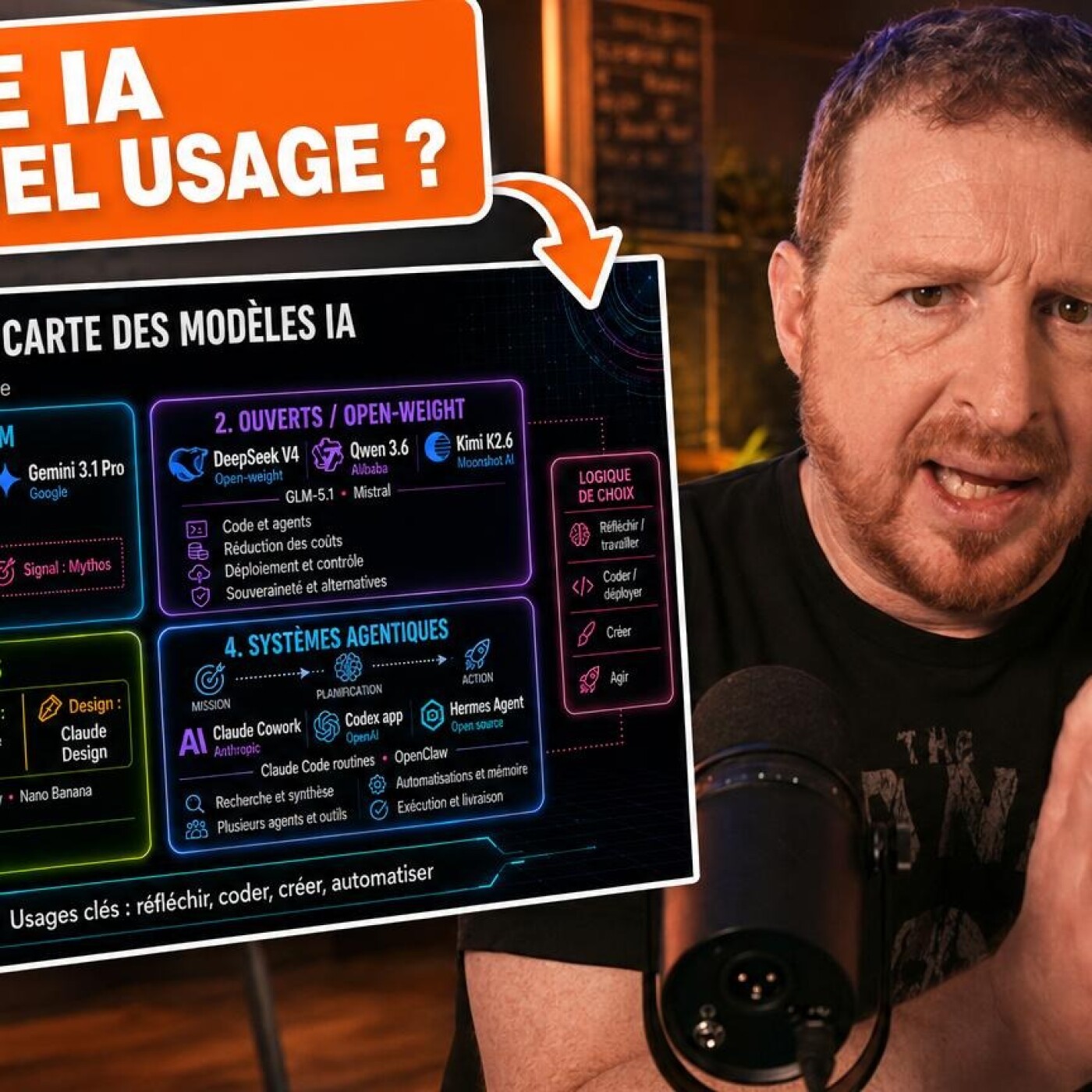
Les annonces en IA s’accélèrent et, en quelques semaines, une nouvelle génération de modèles très puissants a émergé : texte, code, image, voix, vidéo, design et agents. La vraie question n’est plus “quel est le meilleur modèle ?”, mais plutôt “quelle IA choisir selon mon usage ?”. Dans cette vidéo, je te propose une lecture claire du marché et une méthode simple pour construire ton “portefeuille d’IA” : un modèle pour réfléchir et écrire, un autre pour coder, un pour créer des visuels, un pour automatiser, et parfois un agent pour orchestrer l’ensemble. Au programme : 1) Les grands modèles généralistes premium * GPT-5.5 (OpenAI) : polyvalence maximale pour rédaction, analyse, synthèse, productivité, documents, tableurs, planification et usages pro, avec l’écosystème ChatGPT / API / Codex / outils / agents. * Claude Opus 4.7 (Anthropic) : référence pour le code, les tâches longues, le raisonnement structuré et les workflows complexes (refonte de gros projets, livrables structurés, itérations fiables). * Gemini 3.1 Pro (Google) : gros point fort sur le multimodal, le long contexte et l’intégration Google (PDF, images, vidéo, audio, Workspace). Point d’attention sur les prochaines évolutions attendues (Gemini 3.5). 2) Les modèles ouverts / open-weight, chinois et économiques Pourquoi ils deviennent centraux : réduction des coûts, contrôle infra, déploiement, souveraineté technique, alternatives crédibles aux modèles fermés. * DeepSeek V4 : raisonnement, code, agents, long contexte et usages pro, avec enjeux de confidentialité, régulation et géopolitique à considérer. * Qwen 3.6 (Alibaba) : excellent rapport perf/coût, logique MoE, pertinent pour code, agents et déploiements économiques (local/semi-local). * Kimi K2.6 : workflows longs, coordination de sous-agents, tâches de dev complexes. * GLM-5.1 ( Z.ai ) : orienté planification/exécution étape par étape, correction de stratégie, ingénierie agentique. * Mistral (Europe) : option stratégique pour confidentialité, maîtrise, coûts et dépendances (entreprises, environnements contraints). 3) Les modèles spécialisés + la montée des systèmes agentiques * Voix : Gemini 3.1 Flash TTS (narration, doublage, agents vocaux, formation, accessibilité, service client). * Image : ChatGPT Images 2.0 / GPT Image 2 (miniatures YouTube, schémas, infographies, visuels pédagogiques, maquettes), avec FLUX, Midjourney et Nano Banana comme alternatives selon les besoins. * Design : Claude Design (slides, one-pagers, prototypes, landing pages, supports commerciaux/pédagogiques). * VVidéo : Seedance 2.0, HappyHorse et Sora illustrent un marché encore instable, coûteux et très concurrentiel. * Agents : Claude Cowork, Codex app, Hermes Agent, OpenClaw… On passe d’une IA qui répond à une IA qui agit, avec des enjeux clés de sécurité, permissions et responsabilité. Conclusion : l’ère du chatbot unique se termine. Place au portefeuille d’IA, construit selon tes besoins en qualité, coût, contrôle et confiance. Le meilleur modèle est celui qui t’aide concrètement à mieux travailler. #intelligenceartificielle #IA #LLM On en discute ensemble : https://www.renaud-dekode.fr Pour aller plus loin, découvre le Klub Renaud Dékode : https://www.renaud-dekode.fr/abonnement-klub E-learning, entraide, networking et événements privés pour progresser concrètement. On t’y accueille avec plaisir. Let’s rock ! 🔔 Abonne-toi pour ne rien manquer ! Hébergé par Ausha. Visitez ausha.co/politique-de-confidentialite pour plus d'informations.
✨ Episode Outline — click any point to jump to it in the episode
Problem solved
Which of the flood of new AI models to choose for coding, general use, local deployment and specialized tasks.
Benefits
- Clear picks for premium, general, local and specialized needs
- Open-weight Chinese models cut costs dramatically
- Guidance on matching model size to hardware budget
- Knowing which models power agentic systems like Hermes
Use cases
- DeepSeek V4 costs 35 times less when used via API than big commercial models
- DeepSeek V4 Lite needs one or two H100 servers (~€30,000); Pro version needs 16 H100s
- Qwen/Kimi 2.6 can run 300 sub-agents in systems like OpenClaw or Hermes Agent
- Gemini 3.1 Flash TTS delivers cheaper, multilingual, multi-speaker emotional voice via API
KPIs / results
🌐 This transcript was automatically translated to English from the original.
It's a little difficult to see clearly! Well yes because there is an avalanche of new models, new systems, new AI, in lots of different uses and in lots of different areas. There are things from China, open source things, we don't really know, commercial things and ChatGPT responded to Claude who therefore also put a system in place while Gemini is left behind but in fact they are doing their Google I.O. in 3 weeks so they will release a model for us. And then at the same time there are image things but which are in one while we wanted text in the other. And at the same time there are those who stop the video while there are those who rely on it. Oh la la la la la la! Go ahead, we understand that damn, there are everywhere but if we understand it if we follow Renaud Dékode very regularly live every Monday noon, Wednesday noon, Friday noon and then news regularly on YouTube with replays available. Oh yeah, but all that takes time! There are recaps on Sundays, just register on renaud-décode.fr it's free open free, you create an account there, you benefit from the best of the whole community, you have lots of resources, you have lots of tips etc. And lots of things to share and what's more, you'll have a recap of the news every Sunday. Well, you still missed the stuff because that's a lot of models and you have to sort it all out. So shall we go, friends? I'm going to tell you about the different models that have come out, I'm going to tell you a little bit about what use or logic these different models are for. We will start with the large premium general models. So Americans, the exits that we have or we don't have are these. So in order we have Claude Opus 4.7, the middle one from Anthropic which remains to this day and in my opinion. So friends, I'm going to tell you something very simple, what I'm telling you here is in my opinion, okay? Then depending on uses, tastes, tastes and colors, you might want something else. I think that Claude Opus 4.7, to this day, while the first one has also been released in the meantime, it remains a reference in seriousness, in code, in professional, in agentic, in long tasks. When you want to do code stuff with long reasoning on a project, it's Claude Opus 4.7. When we want to do something fundamental where we seek information, reason about it, not make mistakes, not agree with us all the time, etc. You see, deep reasoning, agentic, etc. That is to say, Claude Opus 4.7, that's why. Well, at the same time, just after GPT 5.5 was released. Okay, there it is GPT 5.5. So, GPT 5.5 is out and it’s amazing. Besides, we see it in the LM Arena, I hope we see it very, very quickly. We have these models which are from Claude Opus 4.7, in particular Thinking or the previous ones, which are, which completely monopolize the classic cat in terms of we prefer this one. Yes, but finally, it's not just that we prefer this one. There is also how much it costs. Does my subscription allow me not to be limited every two days? And am I really doing serious, deep, coding reasoning stuff every day that I live with artificial intelligence? No, we agree, not necessarily. Okay, so the real model, the real champion today, in my opinion once again, of the general premium American models, is GPT 5.5. Yes, it goes ahead, in my opinion, it stands out as the best premium general model of the moment. Yes, ahead of Claude Opus 4.5 for general use. When you want to do everything with it, when you want something versatile, which is good in almost everything, which is also not as erudite and precise and all that as Claude Opus 4.7, GPT 5.5 is very good. And at the same time, OpenAI, they're a little more permissive than Enthropic currently. That too can change on everything that is borderline. The usage limits on Claude are a little annoying. At the same time, if we do more in-depth, more serious, more professional things, big, long coding tasks with a lot of context and a lot of reasoning, you're surprised that Claude burns chips. Candy. Well, choose, in my opinion, GPT 5.5, which we had all deserted since the arrival of the latest Enthropic models. Well, I want to say that the GPT 5.5 is the model to have in your little bouquet garni. The main thing, in my opinion, is this. And if we want to go further, if we want to be better, if we want stronger, we go for Claude Opus 4.7. There are American studies coming out, which tell us that we work, we have better social positions, we have better salary, we have better all that when we use Clodopus 4.7. So, there is a side effect in these American-style things. Obviously, if you have money, you can get subscriptions everywhere, including the most expensive and extended ones. Okay, you see, okay. But here it is, this is a bit of my overview of premium general models with the icing on the liner which will be released very soon, it is Gemini 3.5. Today, we are in Gemini 3.1 Pro. We tend to forget the Gemini there. When you want to put big translations, video transcriptions, when you want to put a whole bunch of books, so that it doesn't get lost in the context, it's Gemini. When you want the entire Google ecosystem, it has to be Gemini, to be integrated with all these magical tools, to be accessed from the tools or from Gemini to the tools. In short, having all this logic also on videos, on long PDFs, etc., on documentary research, that's Gemini. However, Gemini 3.1 corresponds to the previous version. There, Claude and GPT took out their last weapons. At Gemini, we have not released our last weapon. However, there is the Google I.O. which is held from memory on May 20, well around that, mid-end of May, so in a few weeks. In my opinion, it is not impossible that Gemini will announce its 3.5 which will perhaps change the game. But in this case, for the moment, we are there. So, GPT 5.5, the great premium generalist. Claude opus 4.7 to go further, higher, stronger, bolder in reasoning and code. And then, Gemini 3.1, if we don't want to change creameries right away, while waiting for 3.5 which won't be long, or 3, I don't know how many, which won't take long to arrive, even though it's really practical to have the Google ecosystem. It's okay, can you sort of see yourself in those? Well, opposite, friends, we have the Chinese models. And here, the thing is a little more twisted, but I'll make it simple for you. Don't worry, it's going to be okay. There, I show you the slide as it is, since there too, there is a second large tilt which comes from the open models, we will say. They are not all open source, they are open weight, but they are almost all Chinese, they are almost all based on the same logic. And there are quite a few who came out. So, I'm going to put aside a little bit GLM 5.1 from Z and I which fits into this logic and which was also released. But I'm going to focus on the three models you see here. DeepSync V4, it has just been released. He's a big model. It's a very big model. So, it has lots of logic that is quite specific so that we can still run it locally. But very clearly, the Lite version of DeepSync V4, it will take one or two H100 servers at 30,000 euros to put a very low-end server in a rack. You see, it's not something you don't run on your PC. And the Pro version will require 16 of the H100s. It represents a small budget, it's hundreds of thousands of euros, and then you have to run it afterwards. But DeepSync V4 is the equivalent of the GPT Gemini thing. A little below the big commercial models, only a little. He is even a little above the generation before. Genus Gemini 3.1. Bim! Ah, DeepSync V4, for certain uses, it is ahead. Well, the use for DeepSync V4 is not so much as an all-day chatbot, because you might as well take a free version of a commercial model which will be a little bit better, that's it, a little bit more configurable. And DeepSync, you'll see, V4 is quite light. You will see it if you discover it. But clearly, to have a big system, a big equivalent, and for a lot less money, it has a super long context, it is capable of reasoning, of code, of agentics. It is extremely powerful, it costs 35 times less if used via API. You can rent the cloud, the DH100 on the cloud to run it in your box, and you can internalize it because it is open. So it's really the open version of the large models from the American giants. It's not for the general public. Do we agree on this? Yes, I say yes. The other one I also spoke to you about recently is Quen. So Quen 3.6. So he, clearly, is the stage location. So it's a bit of the opposite of DeepSync. He is made to shoot almost everywhere. So he’s revolutionary in that regard, he came out a little before the others. But this time, it is the model that you should use when you want local AI. Finally, the model, to use others. But a local open source AI, they know how to do open source, the Chinese, there is no problem, that you recover and it will run, that's very good. He is in mixture of experts mode, like all the small local models. It's a small model. So it runs on your machines. Well, if your machines, it depends. If the machines are very old, maybe not. It will require VRAM. But you can deploy it just about anywhere. Put it in your different systems. Put it in your workflows. Putting it into your agentic systems, etc. Which run locally or on server, etc. In short, Quen 3.6, to be the little brain. There weren't the great minds we've seen until then. Well, that's the solution. And the other model that came out, which is absolutely stunning. So, it's kind of the best of both worlds in one model. It's called Quen 3.6. I told you about it recently. So, it's a big model. It's even bigger than DeepSync, I believe, in some aspects. Because DeepSync, it's super optimized. So, Quen 2.6 is not a small local model either. You won't be able to integrate it. Quen 3.6 is what you need for that. But Quimica 2.6, he is super good at everything that is code, everything that is agentic, coordination of agents. It is capable of working 300 Quimica 2.6 sub-agents in a system like OpenClaw, like Hermès which I spoke to you about recently. Hermes Agent. There you have it, this is the hyper brilliant, hyper professional, hyper strong brain to do code, multi-agent, full-on agentic. To really do complex developments, with long reasoning and somewhat fragmented reasoning like that. Sub-reasonings that feed into main reasoning, etc. He's the little genius of the group. But it's not a small model. Yet it can be used in tools that look like they are tools made for small models. Beware of this. Often, I am told, in an OpenClaw, in a Hermès Agent, in this kind of thing, NanoClaw, etc. We tend to want to make AI open source, for free. So, on his machine, free. Very good, you are right. Yes, but if it's free and local like that, then it's a small model. However, to draw all the power from these agentic systems like OpenClaw or even more Hermès Agent which is magnificently brilliant, they make you a big model. Well yes, but suddenly, Claude, in Tropique, well yes, but it costs a lot of money. It's one who intervenes, who acts at 2.6 to do this, to be the brains of the agents. If you want, to be clear, it's a bit equivalent compared to the big model. Here, if you want, QN 3.6, it's the small model, it's the equivalent of Mistral for us. There you have it, the slightly lighter models that you can download, that you can retrieve, that run locally. There you have it, Mistral's competitor is QN 3.6 and also competes with OSS from OpenAI. You see, the little local open source models that we can all have at home. DeepSig V4 is the competitor, let's say, of ChatGPT. There you have it, the whole ChatGPT range, DeepSig V4 is opposite. That's it, and what's more, well we can recover it and do something with it if we have a big box, it's a big model. And that, QN 2.6, is Claude's competitor opposite, with multi-agentic, code tasks, long tasks, reasoning and all the low strings. You have the panorama, I have given you a little bit of stuff, like European sovereignty. Well, he has Mistral. We fight, we fight. And Mistral is more on this ground, or that one. In short, so you have the panorama of these large models to help you find your way. Is this clear to you? Those are the ones who make up the brains of OpenClaw and Hermès Agents. Those who are local for your workflows, to run really well, those are the ones. Those which are the equivalent for boxes or for buying cloud resources or having H100s in your box and paying nothing, ever. It's the competitor, well, in the ChatGPT segment, it's the one. Is it good for you? So. And then, you have the equivalent in the business models that we have seen. Now, friends, well, there are also other things that have come out. These are the specialized models. We are going to do much faster on this, but simply because the situation has also changed on these models. So, we have Gemini 3.1 Flash TTS which has been released. This model, friends, is a TTS model, therefore text-to-speech, for voice synthesis. This is the model that has folded the game recently. And it's from Gemini, available as an API, etc. He gives you vocals with a natural voice, with emotions in his voice. You can prompt it very simply. It's multilingual, it's multi-person speaking if you want. In short, wherever you want to put AI voice, look at Gemini 3.1 Flash TTS. Unless you want to make music or stuff. So. The model, excellent. And what's more, it's cheaper than others, etc. Particularly at OpenAI, etc. So, there's a crazy thing that came out not too long ago. This crazy thing, Gemini 3.1 Flash TTS. You need a small API account. You don't need a subscription. You can access it directly by API. The second crazy thing that came out is the biggest, in my opinion, of the panel, even if I have difficulty ranking it. It's GPT Image 2. So here, friends, we're going to make it very, very simple. As long as there isn't something new coming out, we're waiting for Google's response. Be careful, we're waiting for Google's response. It's going to happen. So, as long as we have not changed the paradigm with another model that is arriving, GPT Image 2, it is there, in LM Arena. I hope you see the numbers that are here. He outclasses absolutely everyone. So, at the time when I'm shooting this video, when I'm recording with you, we're live, forget everything else, there you go, and go straight to... I'm caricature a little, that's okay, we can caricature a little bit. Forget everything else, go to GPT Image 2. Of course, you might want, for example, to have absolutely graphic, magical inspiration, which transports you to go and save your little mid-day, of course, to be inspired. You might want European sovereignty with Luxe and Black Forest, which are awesome, etc. Of course, you can do absolutely whatever you want. But if you don't want to complicate your life, GPT Image 2, whether in editing, to take photos, to make infographics, to put text in, to do realistic or not realistic things, to make comics, for the thing, well, well, GPT Image 2, you are almost sure not to make a mistake. You are sure not to go wrong. Well, unless there are extreme uses. A bit of the same story on the Seedense side. So there, things changed a lot. You see it at the bottom left, on the video generative AI part, friends. As you probably know, there is a giant who came out of the loop, it's Sora. So, we've had competition for a while now between the first to arrive in video generative AI, which was Sora, from OpenAI, and the second who is VO from Gemini. Well, he's getting in trouble, he's getting in trouble, he's getting in trouble. There, there is one that appeared, it's Seedense 2.0, Chinese, much cheaper, great consistency, the movement that we control absolutely as we want, camera movement, does things around it. It's the most consistent of all the ones I've tested. Maybe I'm wrong, it depends on usage, you might say. In short, you can do absolutely anything with Seedense 2.0. Well, it’s still video generative AI. You will find imperfections in spades. So. Yes, but it shows that it's... Ok, well, wait for 3, 4, 5. Don't complain, go ahead, find out. Seedense 2.0, you're pretty sure you're not messing up as a model. And Sora, there is no more. OpenAI has stopped to focus on everything that is professional and that brings in money by not eating into the inference of their datacenter. So, there is one actor less and he did better than taking the Seedense 2.0 place because he was already clearly above it. The difficulty with Seedense is the accessibility of the model. There you go, it is available in TikTok. Well, you see, the whole Chinese ecosystem. And so, it's a little complicated to go and get things. Well, it's not fair, we go to Seedense and then it's all integrated into something commercial. Well no, exactly. So, that's the small difficulty. And the last little specialist that has also appeared in recent days is Cloud Design. And he shakes things up too. Cloud Design is the layer that allows you to do design and use this layer to carry out application development. For example, you tell Cloud Design, give me a perfect, pixel-perfect model of a website or mobile application. It's okay, is it done? Good. Well, you export what produced you which is an absolutely crazy result. It’s super convincing, super fine. It's not always the same thing. You can put your entire graphic charter, your logo, all that. He's going to use it to add super-clever, super-beautiful little touches. Finally, this is really a big gap in design. It's not fair I put blocks on you and then you manage. No, no. It goes much further. We can also make models, we can make PDFs, we can make slides, we can do whatever we want, etc. Cloud Design is a banger at that. And in fact, this layer, for example, your mobile application screens, you can give it to Cloud Code afterwards, which has been a banger for a while on the code side. And you tell him, you see, this is the little package of the entire front layer that can be seen. Everything that's not visible, because it doesn't work in Cloud Design, is just from the front, that's it. Well, you develop it yourself, Cloud Code. Blim! So, it totally increases everyone's abilities to do things and it's absolutely crazy. So, Cloud Design, there you go. If you want specialized models to note and tell yourself, well, these are the ones I'm testing in Prumps, for design, it's Cloud Design, for images, GPT-Image 2, for video, it's Cidense 2.0. There are aficionados among you who will say, no, I am still a fan of VO. You're right! But those who want to discover and have a reference, this is it. And for everything involving speech synthesis, Gemini 3.1, Flash TTS. Yes, but in Eleven Labs, thing! So. So, I'm trying to give you a panorama reading grid. Now we should detail all that. I end with a last little slide that will interest the most geeky among you, but I very strongly recommend to the less geeky among you to watch this thing and follow this thing. And I'll end there, folks. This is all that is agentic system. Because if there's something that will shake up 2026, the same thing, I've been telling you for a while, but I keep repeating it to you every time because you have to repeat it to everyone. So. Without getting confused. But I know you won't be wrong. But dare to tell everyone. Hey, have you seen agentic systems? What are you talking to me about? Give me the aperitif. No, wait, take five minutes, please, because I have something to tell you. What is this ? Well, it's these agentic systems that have come out lately that are crazy. We had a lot of things come out. Remember the OpenClaw wave? So now, I didn't put it in there, OpenClaw, because it's a little bit dated. And I highly recommend you. You have to go and try Hermès Agent. It's the third one, the one right there. You have to go try this thing. I made you a mega tutorial which was released this weekend on YouTube on how to install Hermès Agent. It's not complicated. It will cost you 7 bucks if you want to self-host it with my partner Hostinger. In short, it's super quick to do. You can do something else in geek mode if you want. If you already have a Hostinger or other host, it's a docker. So actually, anyway, it's a bit geeky, but you install a docker, you have Hermès Agent. I explain in the tutorial everything you need to install it and then play with it. Play with it. With a model, normally, you are not fooled. The model that you can put in it, you can put GPT 5.5 because it will take your subscription but it will not be the best. You can put a latest model fence because it will be the best for this kind of thing. You can also orient yourself, I'm going to move from slide to slide, towards a small Kimi K2.6 which will do the job very, very well in open closes or in Hermès Agent. But hey, I'm still focusing on this part because a lot of crazy stuff has come out lately. more professional than OpenClaw which really does things. It's not just the bluff thing that responds to the cool thing when you're at a distance. OpenClaw, super fun. He saw you, he's running on my machine, he can classify the children's photos. It's great. It's amazing and it allowed us to understand where the agent was going. If you really want agentic in swarm mode, agent farm, sub-agent farm, the thing that improves all the time, continuous memory based on obsidian, on markdown files which will therefore decide for itself who will create new skills under your control to improve what they will do afterwards. The system that allows you to say that I've asked him the same thing three times and well Hermès Agent understands that it's been three times so now I'm going to do things like that differently. Who takes complete control of your machine? Is that why it’s better to self-host? Etc. In short, Hermès Agent really is the new dimension of agentic systems. You have to go find out. It came out not that long ago. We also have the Codex application which is worth monitoring. So Codex, sorry OpenAI but you are seriously confusing things. Codex it was a code specialist model it was an app it's not in the order it was a system integrating the model but not the app it was a platform finally an entry to the code with the model behind finally in short Codex had 3000 lives remember that there is the project which is being formed before our eyes to have a mega app on the side of OpenAI this is what Claude built which I put here so at Anthropi we are building this now we have a Claude app in which there are the connectors in which there are the skills there are the MCPs and there is both Claude the cat there is Claude Cowork the assistant that I was talking about earlier and there is Claude Code the thing that you normally know which is absolutely stunning all in a super app everything coincides it could make overlays in my opinion Claude Design he will arrive in there like that he will discuss with Claude Code who is next but he will be able to feed on Claude Cowork which is next door finally you see the agentic logic agentic system there is the logic we have a great global app Claude goes on it go discover Claude Cowork if it is not already done I have done tutorials on it to see how it works it is your assistant next to you here you know that OpenAI is going on this logic because that is what is needed it is what everyone is waiting for the rest of 2026 and they are going there for the same logic and of course monitor the global systems there which work in your place there it replaces you with a whole bunch of collaborators and a little genius who is in the chair it's more you so here you are the OpenClaw and especially Hermès and John that I recommend you to go see is it good for you all? I'll make it short for you here it is the premium general models this all-rounder the pro specialist we wait for it to come out of the woods very well the Chinese open models if you want to download something locally it's this one this one if you want a GPT chat competitor to do some big crazy things but it's very big but it's super cool and for your agent tests and your magnificent agentic system tools Kimi K2.6 that's the Chinese armada by compared to that the American armada we are good at that the specialized models you do not miss you take those you are sure you are not mistaken but go and discover the four to see what they have in the bidou even if only 3 minutes of cloud design or 4 minutes of TTS to go see what it has in the stomach because it could well surprise you in particular this one and this one then also this one anyway in short they are all surprising and finally the agentic systems it's SAU2026 there is still work to be done to standardize on this by adding bricks but it is already super powerful there is a lot of assembly work here but the response is coming with OpenAI which has already started and then these crazy things from OpenClaw and Hermès Agent which are shaping the future of what artificial intelligence will be or companies that work on their own we will see all that if you want a global overview of this thing there is a global slide I'm not going to bore you because that's what I showed you just before of course that all this is done by the AI which one? what AI model did I use for these slides? it's fastid the answer is above there so no there is no watermark but the answer is above I told you what the killer was the image generative AI which is plaguing everyone at the moment and which is capable of making a slide like that without messing up with everything you need with the right colors the right logos and all the bottom string in short this slide there I will of course put it on the site renaud-decote.fr if you want to watch that again the video the little slide which goes well if you also want to explain to other people around you say hello anyway renaud-decote because I should have put my logo on it but don't hesitate to go and tell that to your colleagues to your boss go and say hold the little slide which goes well to explain the latest model to you and whatever it is for go tell those around you it's important that we don't get dumped by these things and it's so so easy to be dumped by these things right now we have to do everything we can to give a little bit of these indications if you want to go into detail I told you almost each of these tools that I'm talking to you about here I've done either complete tutorials or complete information number of parameters thing how does DeepSync V4 work I gave you an update on this to explain everything behind the scenes of the thing and why it's crazy and why there are weaknesses etc. I have explained everything so if you want to dig deeper you know where it is here renaud-dekode.fr repeat all that and I hope you will see clearly until the next releases especially from Google we are expecting new models which will shake things up again you know what with AI we will update the slides it will be quick see you very soon and discover all that see you very soon