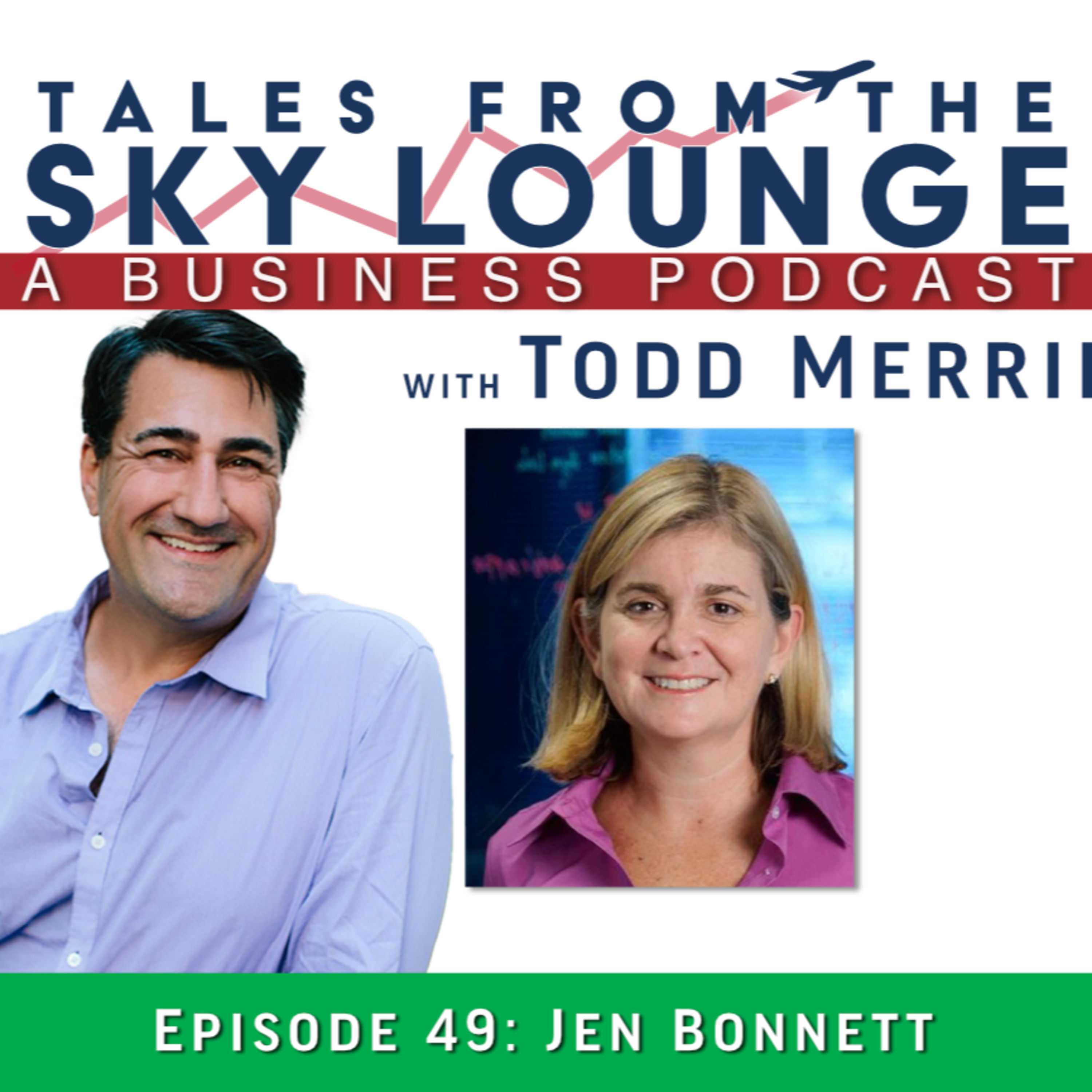
Ep 49—Jen Bonnett - The CEO Is The Salesperson: Why Founders Can't Just Hand Off the Pitch
Tales From The Sky Lounge-A Business Podcast · 2026-06-24 · 65 min
Show full episode description
Today in the Sky Lounge, we are joined by Jennifer Bonnett — a longtime Atlanta tech entrepreneur who coded a search engine called eTour.com in 1997, five years before Google existed, and rode it to one of the most-trafficked websites in the world. After years building Georgia's startup ecosystem at ATDC, the Savannah Economic Development Authority, and Invest Atlanta's Women's Entrepreneurship Initiative, she's done something deliberate: walked away to spend the summer ""playing with AI."" This conversation moves fast across what's actually changing. Jen explains how she sold a no-AI city government on its first pilots, why she runs a Hermes agent that drafts her email every morning but never hits send, and the moment her voice-controlled recipe app jumped ahead because someone across the kitchen said ""next."" She and Todd map out a $30K model for starting companies in an era where software is cheap — and why the CEO still has to be the one selling. Plus: the real case for co-founders, why fewer than 2% of venture capital reaches women, and the three cities Jen has called home. ABOUT OUR GUEST: Jennifer Bonnett transforms ideas into impact. A Technology Executive and Startup Ecosystem Developer with over two decades in software development and IT management, she's built a career on empowering entrepreneurs and fostering disruptive innovation — because in every founder's dream, she sees a milestone for the industry. Her track record spans turning a struggling non-profit into a thriving hub, relocating tech firms, and pioneering programs like the Savannah Logistics Innovation Center, alongside championing women's entrepreneurship through StartupChicks. Today she's most intrigued by AI, Fintech, and Sustainable Tech — always watching for trends that serve a broader societal benefit. CONTACT: Linkedin: https://www.linkedin.com/in/jenniferbonnett/ What is THE SKY LOUNGE? Tales from the Sky Lounge takes you on a journey through business, consulting, and venture investing, hearing stories from the entrepreneurs, consultants, and investors shaping these industries. ABOUT OUR HOST: Todd Merrill is an experienced software executive who typically assists clients as a fractional or interim CTO and CiSO as a partner at TechCXO. He has served in a series of companies as a C-Level executive focused on leveraging the Cloud to bring SaaS offerings to market. As an entrepreneur, turn-around expert, technology and product leader, and mentor, Todd has held full corporate P&L and product development responsibilities and directed diverse international teams of Engineering Managers, Mobile Architects, Developers, Dev Ops, QA, and Customer Success professionals. Subscribe and turn on notifications to listen to new episodes as they launch! YouTube: https://www.youtube.com/playlist?list=PLfeCS-Varb4gu2uCwyRTXWWEdP676Huh6 Spotify: https://open.spotify.com/show/6jz6ubcaUZ20Xh8TXhwzEN Apple: https://podcasts.apple.com/us/podcast/tales-from-the-sky-lounge/id1730134658 Amazon: https://music.amazon.com/podcasts/4ba289a5-0d33-4589-95c7-83416731a864/tales-from-the-sky-lounge Follow Tales From The SkyLounge on Social Media X/Twitter: https://x.com/TFTSkyLounge Instagram: https://www.instagram.com/tftskylounge/ Learn more about TechCXO: https://www.techcxo.com/ Production/Design: James Liebman Music: Soundstripe/Cody Martin-Sunrise
✨ Episode Outline — click any point to jump to it in the episode
Problem solved
Explores how startups and government should adopt AI, and when founders must stop vibe coding to lead.
Benefits
- Frame for staged AI adoption in cautious organizations
- Clarity on vibe coding's place by company stage
- Argues for operations hire over chief AI officer
- Public-data pilots as safe AI entry point
Use cases
- Invest Atlanta went from no AI to dedicated AI point person in two years
- Microsoft Copilot used for secure internal data
- FAQ agent proposed for 4,000-page public website
- Early-stage founders vibe code MVPs and dashboards
- Million+ ARR CEOs too busy with customers to vibe code
KPIs / results
- etour.com 7th most-trafficked website ~1997-2001
- Clustering job took a full week to run in 1997
- 4-5 coached companies over $1M ARR
- Companies with 11-20 employees
Tools / build
- ChatGPT
- Microsoft Copilot
- etour.com search engine (1997)
- Website FAQ agent (proposed)
Hi, welcome to Tales From The Sky Lounge. It's a podcast about business, consulting and venture investing. We get out there in the world and we talk to people who are making it happen and we get their stories. Today's guest in the Sky Lounge, Jen Bonnett. Hi, Jen. Jen Bonnett. Hi, great to be here. It's been a minute. Yeah, it has been. I'm living at the beach for the summer. That's awesome. Yeah, the Georgia coast. So Jen, who are you and what are you working on? Yeah. So I guess, you know, I'm a long time tech entrepreneur turned ecosystem builder in the Atlanta startup community and the state of Georgia. And so I come at into this in the middle of a kind of a life transition moving from an ecosystem builder role back into the tech world. I've been vice president of technology for a publicly traded company. So on the senior leadership team, then I went on to startup land and did a bunch of startups. The startups led me to where we met Todd ATDC. I was doing a working on a startup. And when that company sold, they I actually got asked to join ATDC as a as an entrepreneur in residence. And I spent seven, eight years at ATDC, the Advanced Technology Development Center, Georgia's technology incubator at Georgia Tech for about eight years. And that that that that really was economic development. That is if you want to think about it, how do you use technology entrepreneurship to create jobs in the state of Georgia? High growth, high wage jobs in the state of Georgia. So that actually led me into economic development where I served as vice president of technology and entrepreneurship work for the Savannah Economic Development Authority here at the coast. And then came back to Atlanta for Invest Atlanta, where I most recently have been wrapping up my role as the vice president of technology and entrepreneurship and running the WE program, the Women's Entrepreneurship Initiative. Most people know that I've always been passionate about female entrepreneurs. I was the founder of a nonprofit called Startup Ticks back in the day. And so WE is kind of the culmination of that experience. And now that I'm leaving, I've left those that world. I've publicly declared that I am playing with AI. Yay. I was I've become enthralled with it while I still had the day job, so to speak, and really found that I wanted to spend more time in it. What most people don't know is I wrote a search engine. I coded a search engine in 1997, five years before Google existed. And we were the number seventh most traffic website in the world for several years and the stickiest website in the world for several years. It was called etour.com. I did it in Atlanta with a bunch of founders, co-founders. And that was my first taste into machine learning in 97 through 2001. And so you know that it's actually a public thing and out there in the world. I was like, why am I not doing this? I mean, I am. Yay. Yeah, yeah. So, you know, our backgrounds are intertwined for sure, you know, in the technology community in Atlanta. And, you know, that machine learning really was difficult. Like, it was pretty high engineering load type work back in the day. 97, I mean, gosh, they barely had NVIDIA as a company at that point, right? They were just doing games. I don't think we were on an NVIDIA machine. I had a separate server at the office where we would download the database to that. And then we'd run all of our machine learning algorithms offline on its own stand-aligned server to come up with the concepts and then kind of condense that and ship it back to the server. Yeah. So it would run the job to actually do the clustering and segmentation that we were using took a full week to run on our database before you could put it back up. Today, you would actually ask Chad to do that. And, you know, you'd get a thinking sign for a little bit, pondering, da, da, da. And then, oh, here's the result. Yeah. So I kind of came at this whole LLM thing kind of I was slow to adopt because, you know, like we just get a little bit better email, you know, better paper writing. I didn't get it. You know, coming from that technical machine learning background from so long ago, were you the same way? Did it take you a minute to go, oh, I don't get it? You know, or, you know, what was your kind of path from hardcore, you know, technology background to, oh, this one's different. Like this is like, you know, somewhere in the last year or two, things got something changed in profound ways. What was your kind of path to, you know, this is cool and I need to jump on? Yeah. My path was slow in part because city government is slow. And so we actually, the rule when I ended up, when I joined Invest Atlanta was no AI. At all? At all. That was the rule. Okay. So I had to work on convincing them that that was not the right rule. I will say, though, I was shocked when it happened. Like when ChatGPT first came out, I was shocked that it happened. I wasn't shocked that it existed. And I wasn't shocked at how far it's come based on computer power from 97 to now. I was shocked that they released it to the public. Right? My theory was Google and these folks have had AI and machine learning agents running behind the scenes, engines running behind the scenes to do what they do in their own business. And the fact that somebody decided to open the kimono and ship to the public was the thing that I found shocking. And then once OpenAI did it, everybody had to run around and try and get a consumer friendly version of it. They might have had some clunky version that didn't need a nice interface. Right? Because it was their engineers using it. Right? It was their staff using it. So my theory is like they've been doing this for years. And that OpenAI surprised everybody by releasing a consumer version of it. And then everybody else had to play catch up is my theory. Now it's an arms race. And then here we go. Yeah. Yeah. So there's a lot to that. You know, I talked to a lot of companies, you know, that are beyond startup stage, right? Mid-market enterprise, government. And, you know, everybody has regulatory compliance problems, right? And a lot of concerns over data privacy. A lot of concerns over, you know, we don't want our data to make it into the model. You know, we don't want them to train on us. I think that's held back a lot of progress, you know, in the corporate world. You know, you look at Anthropik and OpenAI, you know, doing these forward deployed engineers trying to figure out why corporate doesn't adopt. You know, but what, you know, from where you're sitting, you know, what do you think the motivations were? Are people scared of it? Is it like more like law or technical or? So I think, you know, when you think about the data that a city or an economic development authority has related to its programs, we have a lot of private data. And so you have to be very careful, right? And so the data has to be, first and foremost, secure internally before you can worry about securing it externally, right? And so, you know, my pitch to Invest Atlanta to actually start doing, allowing AI was, look, you know, we have 20-somethings, 30-somethings that are staff members. And while you might be able to block it from being on their computer, their work computer, they have ChatGPT on their phone. So they're using it. They're asking it questions. It's helping them craft messages. It's helping them do things. They're doing weird cut and paste stuff, and we don't know about it. I'd rather know about it. I'd rather have some rules. I'd rather, like, say, here's how you're allowed to use it, right? Because they are using it, is my guess, right? And so, like, you know, the – I said, you know, so the idea was let's come up with some pet projects that we could do to test with, right? And, you know, they're a Microsoft shop, so it's Microsoft Copilot. Okay. Not great. But it is. It is what it is. And it's, you know, it's secure data. Their cloud is secure through Microsoft Cloud, right? And so it is what it is. We could talk about who's going to win the race in the long run if you want at some point. But I think that was the foray in. And, you know, I said, like, hey, you know, what if we just use public data? Like, everything on our website is public data. Our website is way too complex. What if we used it to simplify Q&A, you know, FAQs for a little agent that you could talk to and get answers from the website since we have, you know, a 4,000-page website with all this different policies and stuff. Right? Why don't we just do that, right? And so start with public domain. What data do we have that's in the public domain that we could better use, better train on, whatever? And now they've actually assigned a person that used to be on my team. I lost her. Aw. And that's all she does is she works with different departments in Invest Atlanta trying to think about how they can use AI better to be more effective. And I, you know, and I think it's great because they've, you know, in two years, they went from no AI to like, okay, at least we have a point person and some policy and some mechanism to try pilots and see what works. What, just out of curiosity, what title did they put on that person? I don't even know. Sorry. So that's a big, like, so I wrote a paper, you know, is that a, well, and so do you hire a CAIO, chief AI officer? Yeah, she's not that high level. She's more of a, she's a program manager, project manager level. She does have a certificate in project management. And so, you know, Invest Atlanta doesn't even have a CIO or a CTA, right? So I think, you know, that they outsource all their technology really to an IT firm. And one person that's a manager on staff. So that manages that outsourced relationship. So I think, you know, it's a big deal for them to put a full-time headcount on working with the different departments and training them and teaching them and looking at what projects they could do. So I think it's a big deal. I think they're doing the right thing. I'm excited to see it happen. And I know that they're doing good things with it. But, you know, that's from two years from no to, hey, we have a headcount thinking about this. And educating other people as I go from department to department, each department's sort of getting trained in what things they might be doing that might be, you know, able to enable some sort of agent to do part of the work or whatnot. Yeah. I think it's largely evangelical, you know, demonstration of capabilities right now. And then I think my theory is that you need a COO or chief of staff or an operations or project person way more than you need, like somebody with deep AI domain experience, right? So the AI tools are what they are. The real problem is the change management and the people and the, you know, just letting people know, you know, what's possible. I think that's kind of where we are now. I don't know. Do you buy that or do you think that was an effective hire? Actually, a lot of my conversations with some of my later stage females, okay, later stage. Let me define that. They've hit a- Well, like on the investor side or the, like, more successful? Yeah. So, you know, I coach a lot of female entrepreneurs, right? And I've got everyone from idea stage to, you know, I guess four or five of the companies that are about to graduate from the REU program are actually over a million ARR. And it's interesting because all the very early stage companies, almost idea stage, are really into vibe coding. They vibe coded their solution, their vibe coding dashboards, and this, like, this is how they're managing. The CEO of the million-plus ARR company that may have 11 to 20 employees can't vibe code. I mean, they don't have the time, right? They don't have hours a day to go play with AI. They have customers, right? They have traction. They have real issues and people to manage and all these things. And so one of the women I was talking to, and she's like, I really should be vibe coding. And I said, should you? That is the question that I keep finding myself asking is, should you? Like, at what stage does the vibe coding become somebody else's job? I get it in the early stage idea stage companies. Like, there are so many people that haven't been able to find that technical co-founder. And vibe coding gives them the ability to build that very first MVP and put it into the market to see if they can get any traction. And now they're vibe coding and it's fun, right? But at some point, don't you have to become CEO? Well, it's a little bit of a trap, too. You have to become a CEO. You have to deal with partnerships. You have to deal with investors. You have to deal with customers. You have to deal with employees. And that's where your focus has to shift. And so this is where I think that director of operations becomes really key in these growing startups because they're probably the one that has to own how AI is being implemented at a process perspective, not the CEO. Yeah. And then that's where I'm coaching people now is don't hire a CAIO. A CAIO, yeah. And hire an operations-focused person. It doesn't have to be a C-suite. But somebody understands people process and then probably a little bit of technology. And then you probably need one or two. Remember, like back in the day, I worked at Bell South Cellular for a minute. And we had the software team and then we had a couple folks that were in the back office working with the business team that would do a couple little quick apps that were Windows apps to help the business people. And they took like two seconds to generate. But I think we're going to see a resurgence of that capability again where it's business-focused IT applications. I think we're calling those agents today. But I think there's going to be – like it's not a super deep engineering discipline. I mean, I guess it could be, but it doesn't have to be. But you need a couple of folks. You know, we used to call them web monkeys, right? That's a horrible term. Hey, wow. But I mean, a couple of people that could hack very effectively, you know, maybe web ninjas is a better term. But, you know, hack together a couple of very effective things to help the business. Yeah. But they need to be guided by somebody who understands the business from an operations point of view that's right next to that CEO. CEO needs to go be selling stuff, talking to customers, investors, that kind of thing, I think, right? Yeah. I agree. That's the whole, you know, idea of this $1 billion unicorn. Unicorn. With one employee. I'm like, yeah, probably not. No. No. Probably not. Yeah. Right? But, okay, maybe. But, you know, I'm going, no, you're going to need people. There's going to be people in the loop. They're human in the loop, so to speak. And, you know, the question is, like, you know, at what stage does the person that Vibe coded that app need to be building that team out? Mm-hmm. Right? My current advice to people is, like, as soon as you think you have traction, you start to show that you're going to end up with customers, you better be finding that co-founder technologist. And people are like, well, I'm not going to need a co-founder because I Vibe coded it. I'm like, okay, so you're going to be CTO and CEO forever? And they're like, oh. No. You don't understand. Like, there's a lot of work on both of those, right? No, you really can't be. So you should still be looking for a co-founder. I'm like, well, maybe they don't have to be a co-founder. And I'm like, well, then you're going to have to pay them more. They're like, yeah. They get a little confused. I'm like, yeah. So a co-founder is really just somebody that's working for Sweat Equity too, right? Right? And so you want a co-founder. Trust me. You want a co-founder. Yeah. I always thought that two and three person teams were way better than any one person, regardless of how talented or connected that one person is. Definitely. Definitely. And then it's just, well, one, you've got the division of power and different responsibilities. So you're getting multiple things done at the same time. Secondarily, it's just the emotional support. Like, with my, you know, with Nexpence, there were three co-founders. My company that I did, the Esquise Management Company that I created at a hackathon at ATDC back in the day, right? Ah. Oh, okay. There were three co-founders that I met at the hackathon, right? A marketing person, a technology person, and me, even though I was somewhat technical. Right? And, like, I might be having a bad week, but they carried on, right? Or they might be having a bad week and I carried on and, you know, helped pull them up. And so, you know, it's a rough journey doing a startup. A very emotional rollercoaster. And so it's always good to have multiple people on the team because you're probably, you're hopefully going to be able to lift each other up when one of you is going through a hard time. Absolutely. And you will, right? And it's almost a daily thing at Startup Life. But so let's talk about vibe coding. Yeah. You know, what's your poison of choice these days? Like, what do you, how do you, what are you thinking? Like, you personally, you're technologically, you know, sound background and you've got a good experience. You know, what do you reach for when you go to VibeCode stuff? So I'm using a little bit of everything for things. But yeah, so cloud code is my go-to for coding. I will say it took, like, so I hadn't really coded since we're talking like 2015. So, and I've never coded on this MacBook. So it took me almost a week to get everything set up that I could really code again. You know, Xcode, my Apple developer license, you know, all that sort of stuff. React, Node, all the different tools that I was using for that. And so it took almost a week of just environmental setup. That was pretty frustrating. But yeah, so I'm pretty heavy. I'm weird, I guess. I like the Cloud desktop app for conversation. For ideating on business ideas. Because I've written three skills for Cloud in there. One's a business plan skill. One's a PRD skill. One's a wireframe skill. That I use over and over again. So I could basically throw an idea in there and let it create a business plan for me. In that skill, I told it like certain websites that I wanted to do in its research phase, like TechCrunch and if it's an app, app engine and some of those things. So the details are pretty specific as to where the data comes from. And that helps me really kind of go through an idea pretty fast. You know, we're talking less than, you know, less than six hours from idea to PRD. And we're ready to build, right? If it's just an idea, right? And so, but a lot of times you get to the business plan and you're like, is this going to be worth it? Right. So, so I'm using the Cloud desktop for those conversational things and producing documents. And then if I decide to code something, I'm in Cloud code in the terminal. So, yeah. And that's been a learning curve again, too, right? When I first, when I coded next month, I coded the app. So I was in, I was in terminal quite a bit. I was in Xcode quite a bit back in the 2008 to 2009 timeframe. But I, you know, any coding I've done in between now and then has been HTML, CSS and JavaScript. Maybe a little PHP here and there. So not, not deep, right? And so now I'm, I had to relearn all the terminal commands. I mean, trying to find the hidden files for the first time. I was like, wow, what's that dash? Yeah, that's LA. Why am I remembering all those things? So I had to like, it's been a, it's been a fun learning curve, but yeah, I'm in, I'm in Cloud code for that. And then since I pay for ChatGPT2, and I guess I pay a little bit for Gemini. I'm not, I'm a heavy Cloud user, $200 max plan. And then the other plans, I think I'm $100 ChatGPT. And then I think I'm $20 on Gemini. But I want to learn all of them. I want to know what I should use what. But ChatGPT is actually built, designed the logos for the couple of different ideas that I'm playing with right now. It's pretty good at web copy. I haven't necessarily, sometimes I go back and forth and ask both of them to create web copy and then decide what I want to do. So, and then because, so I had OpenClaw running on a virtual private server for a while. And that was right around the time that Anthropic said no to OAuth. So that's why I upped my ChatGPT plan because that became my primary for my agent. Okay, for your OpenClaw. OpenClaw. Yeah, but now I'm not, OpenClaw is, it's out there, but it's actually not running. I just turned it off. And on that same server, I installed Hermes. And so I'm now kind of a Hermes agent person. That's the second time in 48 hours I've talked to somebody. And that, that's ChatGPT 5.5 is what's driving my Hermes. Okay. What do you think of that? Is there, do you worry about your data? Do you, are you delighted about what it can do or jury's still out or kind of where are you on that journey? I'm loving it. I mean, it's, it's super amazing. So my Hermes agent wakes up every morning at seven o'clock in the morning and checks my calendar and checks my emails. I mean, currently using a Gmail account that I've had for 20 years. So there's a lot of crap in that. Yeah. To be honest. And it, it's instructions. I've trained it basically through pretty detailed instructions that I really want it to focus on people. So if anything looks like it's an actual person and needs a response, like that's what I want you to pay attention to. I want to be able to like, have you find the signal, not the noise. And it's amazing. It is spot on. It, it finds the people. It drafts the response. I don't let it send. So when I wake up in the morning, I have a draft folder and, and any email that came in on draft folder, it puts a little color icon on it, like a tag on it. That's a different color. So I know that there's an email response there. I can review it. I would say that it's overly ambitious as to how many meetings I want to have. I can review it on that. It's like, it wants to tell everybody like, oh, she's available at three today. I'm like, no, I don't want to be available at three today. Right. Right. But I get to change that before I send it. So it's okay. It looks at my calendar. It tells me what meetings I have in the email. It's super interesting. It will actually find something like, hey, there's a LinkedIn message from somebody that you don't know, but it looks like they have a speaking engagement that you might be interested in. You should check your LinkedIn. I didn't ask it to do that, by the way. Oh, super interesting. Yeah, it is a little creepy, like how it learns what you like. But I figured it out, right? And then, so that's one job I have. I have a job that runs at the end of the day, every day at four o'clock. It just ran. That reviews my stock portfolio. Just to give me a glance at, like, do I have to think about doing something tomorrow? I'm thinking of adding another one that's actually some of the stocks that I didn't, or maybe updating that one to say, here's a watch list. If any of these stocks drop below X percent, let me know. And I might do that a little bit earlier so I could buy the same day. But I don't know. I have to think about that one. So I have a stock one. And then I have a time tracking app that Hermes tracks my time. So I realized that I wasn't, like, I feel like I'm all over the place. I have all these little projects and I have all these things I want to play with, right? And I just feel like I'm distracted all the time. So I was like, well, maybe if I track my time, I'll be more focused, right? I'll be able to look back at the end of the week and see how I spent my time. And so I was like, well, I hate tracking time. I really just want to say out loud, hey, I've tracked four hours to WE today, the Women's Entrepreneurship Initiative. Track those four hours. And be done with it. So I asked Hermes if they could create that app for me, and it did. So now I can just go into Telegram and either text or hit the voice record and say, hey, put log four hours towards X. Log one hour towards whatever. Put a description. And at the end of the day at 6 o'clock, if I haven't logged any hours, it pings me and reminds me to log hours. And at the end of the week, we'll see tomorrow, I'll get my first report. But that's been super effective. I just started that this week. And so, yeah, I'm super excited to see how that works out. Because time tracking is like if you're doing consulting or you've got lots of projects that you're trying to manage is such a big deal. And now I don't have to do anything for it. I just have to talk to my phone to tell it that I worked those hours and it will track it for me. So let me, so having a little bit of experience with Hermes and OpenClaw and CloudCode and coding tools in general, there's a lot of people, you know, there's like the vibe coders. They're just like, let's go, you know, make me an app. Go. Don't make mistakes. It's just like one end of the extreme. But I call it like a dark factory mode of operation where you just kind of give it some goals and say go. And then there's kind of like this other more conservative, you know, end of, you know, people who are in business that have production loads that are kind of coming at it a lot slower of, hey, you know, yeah, you can take on, like you were talking about with the city. You know, you can take on some workloads that aren't, you know, risky and that, you know, if it works, great. If it doesn't, that's fine too. You know, nobody's going to die, you know, kind of workloads and kind of inching your way up. Where do you think, where do you think we should be on that spectrum? Or do you have any thoughts on, you know, is the software world ready for dark factory type, you know, is that the future? Where are we going? Or what do you think is about to happen here? Is that scary or like exciting or weird? I think it's super exciting. I think we're closer to it than we would all like to admit for the most part. I mean, there's been recent articles that basically say Claude's writing itself right now. So that's super interesting. I will say, like, I do have Visual Studio installed on my computer and I do have it open to the project where Claude is putting the code. Right. And I do look at the code. Some, right. Like, especially if there's a problem. And in part because I want to know, like, where it's placing things. Right. So, I mean, so I think it's super interesting. You know, I think it's much further than we think it is or than we want it to be in some cases. Right. I sometimes forget. I get stuck on something. And, like, get all stuck in my head on something like, like, in the Apple Store. Before I released this app that I'm building right now, one of the boxes is do I own the content in the app? Okay. Okay. Well, part of it's kind of user-generated content. So I don't really own that. And I got stuck for, like, an entire night, like, going in my wheels in my head, going, like, how do I answer this question? And then I'm fine. It's just like, oh, shoot, I should just ask Claude. Well, and what was the answer? And Claude needs to be a really good answer. He's like, yes. And here's how you explain it. Right. Here. And that is going to, when you check this box, it's going to do the, this box is going to open and you're going to have to defend it. And here's what you're going to put in here and did it. Right. And, and, oh, here's other sample apps that do similar things that are all in the store. Right. And have passed. It gave me a whole defensible, basic white paper to put up there. So I was, but I was ruminating over, like, how do I answer that question myself for like overnight, like losing sleep over it. And the next, I don't know, I just asked Claude. And so, yeah. So Claude answered the question for me and I moved on. Yeah. Well, so I think, you know, there's that. And then I do, you know, I don't yet know. Like, so we, we told a little bit about my origin story, right? I wrote, I wrote a search engine before search engines existed basically in 1997. The hardest part about that is I was, I was always been a software engineer prior to that. And it turns out having a very large scale website is more about hardware than about software. I mean, there are certain things that you can do to the software to make it more effective. You know, key structures on databases, indexes, primary care, all sorts of stuff that you can do. Making sure your code's as efficient as possible, right? All that stuff's super important. But at the end of the day, when 17 million people are going to hit your website in the morning, it's about how many servers did I have online that day? Load balanced. That could handle the load. It wasn't about my software. And so that's, that's the thing that I don't, like, I haven't, I've been vibe coding. I haven't deployed my app to the public yet. I'm, I'm really close, but I'm not there yet. So what happens when I deploy? That'll be, that, that's kind of my next interesting challenge I said, I suppose is, okay, I built it out. I'm going to put it out into the world soon. Now I got to figure out how to market it. Do you have a name for it? Is it something we can share with people? I'm sure Claude's going to, you know, give me a really good plan to market it. Yeah. So it's an iPhone app. I call, I call it Cook Out Loud. The website is cookoutloud.com. It's an app where basically it doesn't take care of the search for recipes. So I like to cook. I really do like to cook, right? And the challenge is when you cook with your device, the device does that. It goes black. It logs, right? And even if you find the recipe that you like, the recipes always start with this story, right? You have the story and the pictures and the whatever, and then you scroll all the way down. And then it's got the ingredient list. And then it's got the directions. And every time your phone freezes up, locks up on you, you got to reopen it and then you got to scroll again, right? And you got butter and flour and stuff all over your hands. So you're getting your device all gooey. So I just created an app where you can basically paste in the URL of the recipe that you want to cook. It processes that URL and it strips out the ingredients list to one tab and the cooking instructions to another tab. And then when you're ready to cook, you hit start cooking and it just starts reading in the directions. And you can ask it to go to the next step. You can have it repeat a step. You can ask it the oven temperature again. You can ask it certain questions. It's not totally trained, so you can't ask it like crazy questions. But there's been some prompts that I've gotten written into it. And then you can do one recipe like that for free. That's the freemium version. If you want to save them, then there's a subscription cost. And then the other thing it does for the people that are subscribers is I have a food allergy. So I'm very sensitive to gluten. And so if I would pick a recipe that has gluten on it, I want it to warn me before I start cooking, right? Or to suggest substitutes and be able to save the substitutes. And so, yeah, it's pretty fun. I use it all the time. I just made – two nights ago I made a Dijon hot honey salmon roasted vegetables. Oh, man. That sounds awesome. Yeah. Yeah. And we were testing it. So I was at a friend's house and we were cooking. And actually, I was cooking and they were talking. And I found out I have an ambient noise issue. So the phone's there. I'm cooking in the kitchen. They're at the barstools over here. And if one of them said something that sounded like next, I lost my place because it would go in. I was like, okay, we have an issue. Yeah. Yeah. But now this is how you learn. So we're testing it out and hopefully it'll be in the store soon. So experienced founder, mentor, investor. Okay. So getting an app is kind of a lot easier than it used to be. So what in your mind is like the important next steps? How are you going to take this to market? How are you going to attack? You know, other than, hey, Claude, go market this for me. You know what? What do you feel like is the next steps in a classic, you know, ATDC style startup where you say, okay, it's a good start. You're not quite to market yet. Here's the next steps. What's your advice? Yeah. So I've already messed up. But you're having fun. So this is fun, right? Well, and it's awesome. So I'm kind of using it as a, I'm testing a process. I'm testing a, hopefully a repeatable process to build multiple apps, right? And so I think I mentioned I have a skill that's a business planning skill, right? So you go from the business skill to the PRD to the wireframe to the cloud code to code it, right? And then now I've got to start thinking about the marketing skill. In the real world, I probably should have started marketing already, like building public, right, is the new thing. So I'm not out there marketing this at all. I'm not even, I had to mention it to friends. Everyone that I talk to wants it. But I'm also, you know, the key differentiator, recipe apps is a very crowded space in the app store. And the only real differentiator is voice. And so if you have a recipe app, it's going to be very easy to add voice. Mine takes off, everyone's going to add voice, right? So it's not really a defensible product. It's not a product that I think I could raise money around. It's none of those things. It's quite, it's fun. And I'm learning, I'm relearning to code using vibe coding. And I'm building a process that I can do repeatable. So, but yes, I should already have social media handles for it. I should already be posting on TikTok and Instagram about it. I should have some probably Hey Jen fun video that has a person like with messy stuff all over in their phone, touching their phone with flour and butter in her hand. It's dripping, the phone's dripping. Right, yeah. And then, hey, with Cook Out Loud, it's got none of this, right? I can see it now. The video that I'm going to create with Hey Jen or one of these video generation tools, right? But yeah, that hasn't, I haven't been doing that because I should, I should, I need to start this right now. So many thoughts right there. You know, and you know, lessons for the next generation or then, you know, there's entrepreneurs that want to get into the market. Just because you have an app doesn't mean you're in business. You know, you got to, you got to show people and get out there and market. And then I think one of the, one of the really cool advantages you have, right? Is you mentioned you went to ATV Sylvan. You just kind of popped in for a second and said, Hey, I'm here. And then you had 600 hits on your LinkedIn. That's insane. Right. And then that's a lot, probably a lot of important people that would take your phone call and probably want to call you. That's distribution, right? So that started 20 years ago because you, you, you cultivated your network and talked to lots and lots and lots of people about lots and lots of things. You know, so that's an unfair advantage. You know, if you are starting a company and you're kind of, you know, in the back office of some company and you never talk to anybody, you don't have that advantage. You know, how, how do you compete with that? You know, somebody's got to, you know, in an age where everybody's got claw bot or clawed or chat GPT. Hey, go buy me some Google ads and some Reddit posts and, you know, LinkedIn posts. Like everybody's got that. Like, how do you, how do you, how do you get through all that noise? Right. It's easier than it's ever been to start a company, but it's also harder at that second. Like build stuff, sell stuff, you know, product market fit are kind of my three milestones I want people to hit in the first like quarter or two of existence. How do you think about that? Or is that the right kind of milestones? You said market early and often, right? Yeah. You know, I think that's, that's the mistake I've been making so far on this project. Right. But it's, but it's okay. This is not the end all be all for me. I don't, I don't expect to be running a cooking app for the rest of my life, by the way. If it, if it works, I'll probably give it to a friend to run, by the way. Yeah. No, it's fun. Right. It's been fun. Um, but yeah, I think, you know, yeah, you have to be out there. I do believe relationships are, are going to become even more important. And, and I don't, there's, I, I'm mentoring some young Emory interns for the summer. And one of, one of the things that I was talking about them is like, they're, they're very task driven. Right. Here's, here's the things that you need to get done. But like, I'm more like, how, what are you learning from those things? And let's not rush through that. Let's learn. And, and, oh, by the way, some of these things are interviewing people, customer discovery. Right. So I need you to go out and spend some time. I need you to think about how you're going to talk to these people. What questions you're going to ask. You can ask Claude and ChatGPT to help you with the interview questions. Right. You can actually ask Claude and ChatGPT to pretend that it's your ICP, your ideal customer profile and answer the questions that you ask it. Right. To practice interviewing customers before you start going out to do the customer discovery. So this is a new tool for that. Right. Right. Um, but I think relationships is, is really, you know, I've spent, yes, I've spent 20 plus years building, building a very strong network. Um, and that, that, and for the folks that are listening that don't know me or, or, or think that I'm an extrovert, I am not an extrovert. I'm an introvert. I would, I would rather play with my Claude code all day long than, than go to a business after hours or a happy hour and networking or AI tinkerers or whatever. Right. But you got to get out of the office. You got to go talk to people. You, you learn, um, meet new people and learn something from them. Right. And, uh, build those, build those relationships because that's where the rubber's going to throw it. You're going to meet an investor. You're going to meet a customer. You're going to meet those key people that will help you grow your business. Um, let me kind of shift gears for a second here. So, um, do you, so, you know, let's explore like, okay, if vibe coding is a thing or maybe call it agentic engineering, uh, the cost of software has come way down. Um, it, um, the kinds of companies that we can go found now, um, is impacted by that statement. Right. So not everybody's got to be a billion dollar unicorn to make this work because you don't need $5 million or quarter million dollars to get started. Do you see a resurgence in this kind of, you know, we used to call them lifestyle businesses where, you know, people can now profitably get to market and then go out for business that might make $5 million or $10 million ever, ever in the whole life cycle of the business. But it makes sense because a couple of folks can make a real good run at that, you know, and then be profitable and, uh, and do a good job. Right. And then do you see, do you see that emerging as a class? And then as investors, how do we, how we think about this? Yeah. So, I mean, that's, that's always been a class, right. Especially for women entrepreneurs. Women entrepreneurs raise, you know, less than 2% of our venture capital. So lifestyle businesses are, are 90% of what women business owners build. Right. So it's always been a class. It's just now it's much more tech enabled than ever before, I suppose. Um, you know, and who's to say that, I mean, you may end up stitching together like five of these businesses in a related field. Right. And then like, uh, I, like, like even, you know, my, my second idea that I'm is on the back burner that I haven't started right now is that as I actually see, like, there's probably four different apps that under one brand. Right. And so I think, I think you might do that, but ultimately I believe like, I've always believed because of how many women I work with is like, there is no wrong type of entrepreneur. Oh yeah. Right. And so depending on your stage of life and, and your vision for your company, that's going to drive whether or not like you can raise capital. Right. Um, if, if, if you want, if having a small $3 million business is awesome, right? It can be awesome. Right. Um, having a billion dollar company can be awesome. Right. But, but it, I don't know. I think it depends on you. I think it depends on the person that's building the business and running the business. And they, I think it takes some soul searching to figure out what kind of business you want to build. Um, you know, I've raised venture capital. I've bootstrapped. Right. Um, I've had exits from both types of companies. Um, both were fun. Um, you know, capital gives you the ability to hire the best, to spend more money on technology, to spend more money on marketing, to spend more money on ads, to build a, possibly a stronger team. I won't say it's always true. Um, so that's, those are, those are reasons to go raise capital. Right. Um, but sometimes you can build just a stronger team just because everyone's passionate about what you're solving. Right. And so, um, I don't really know, like I'm, I'm kind of struggling a little bit with what happens with venture and, and investment. Um, and I'm starting an angel group, right? So I've started a women's angel group called Trailblaze Her, TBH Angels. And, um, what I do know is that early stage female founders that hit some sort of, get some sort of validation that they have product market fit have traditionally had almost no ability to raise money. And then therefore we never really know how big their business might've gone. Okay. And then what price point, like what, what revenue point are we talking about where they go out and try to raise or what do you think the problem is? I got three startups that are getting on stage next Tuesday night at the week graduation that all have over a million closing in on 2 million ARR and they've never taken an outside cent. That's awesome. Right. And it's great. Right. And they've gotten this far. Um, at least one, once one's getting an SBA loan currently, another one is going to raise money at this event or this is the start of their race. Right. And, um, you know, that's, I sometimes wonder though, this will be a pre-seed round. Right. What ha is there an A? I don't know. Right. Is there, I don't know what's going to happen eventually. I really don't. I feel like you either need a ton of money. You need, if you're building the LLM and, and the company that needs those used data centers and all that, you need a ton of money. So they're raising billions. Right. And then you got all these small startups that are able to do so much more with so, so much less. You don't need that first check. You don't need. Traditional first check. Right. You don't need as much, but at some point you still need some money to grow. So I'm, I'm still like, okay, I think I believe heavily in pre-seed and seed. I don't know what the later stages look for non-infrastructure companies. We won't need as much. Can I throw an idea out? So I've been kicking us around. And so, you know, you and I have talked about like, we should do a venture studio, you know, something kind of cool. Right. I think, you know, not that we're going to do that, but, but it's fun to think about. And then is that the right asset class? And then, you know, you mentioned like doing three or four companies back, you know, side by side in the same kind of umbrella. You know, I think that could be fun. And then, you know, people have done that successfully in the past. Nobody's celebrated it. But I think in a world where you can generate a lot of software very quickly and then share talent that gets, that has connections and can go to market and has the distribution through, you know, social media presence or whatever, a great network. Um, I think that could be a super powerful combination. And so I've been kicking around, okay, what's, what, um, what are the capital requirements? And then what, what could an investment look like in something like that? And then, so where I came down to was, Hey, if, if we could fund, well, so, you know, you, you could get somebody to write a pretty good chunk of software for you for a little bit of cash, like 10 grand or 20 grand. And then, um, you could probably get somebody to market in the same way for 10 or 20 grand and some equity. And then same thing with, you know, your first, for sales rep maybe. And then, so all that together, maybe 30, 35, 40,000, and then maybe some 10, 10 grand in ads or airplane tickets or whatever you got to do to, to get it going. So you get squinting kind of hard and it get in through those first couple, three milestones very quickly for 50 grand. If you could, and then, and some equity, right. And then if you add in like maybe a rev share kicker, um, that kind of investment, um, starts to look like a rental house almost, right. So you put a 50 grand in, you get equity, long-term equity upside probably, you know, and then, and then you get return of capital along the way, maybe not this year, but probably next year. That's a whole different risk profile than traditional angel investing, where you kind of put 25 grand or 10 grand in and then pray, you know, and then the whole venture model that the thing that bugged me was, Hey, you do 10 deals. We're betting on half of them absolutely doing nothing. You know, I need one that's going to a hundred X or 10 X, and that's going to make the whole, the whole fund. And then a couple like, you know, double or triple. Right. And then why don't we, why don't we be more intentional about starting these companies? And then kind of like you were saying is, Hey, I ran my little tools early and I, I knew like, I'm still doing this cause it's fun, but I knew early that this is not going to make money. Like let's, let's, let's shift that decision earlier. And then, and it's discovered that this is not going to go and just do another one. Um, and don't spend hundreds of thousands of dollars to get started on, on ideas clearly not going to run. And then, and then like you're saying market early, even before software, because software, you don't have to have software to market an idea, right? You can go out there and talk to people about, Hey, I'm going to do this. Is that something that is interesting to you? Oh yes. But maybe this twist, then you can ask all those important questions early. So can we, can we, you could, could you see a world where we have like a nice little funnel of super early, um, basic singles types companies and then fail fast. You know, everybody gets shot. Um, if you don't hit those milestones in a quarter or two, like, I don't want you to be a year or 18 months down the road and a quarter million, half million, a million dollars raised and never have sold anything to anybody. Like that's not forgivable anymore. You know, we need to, we need to spend a little bit of money, get them, get them, you know, Hey, you as a founder don't need to be a salesperson, but you do need to sell something to somebody that you least the first few to prove that this is a thing. You need to be a sales, I'm going to be really blind. Okay. CEO is a salesperson. Okay. I think that that's, there's wisdom in that. Um, I think you can be a founder and start a company, but you're going to need somebody leading the sales, right? Okay. Founder needs to be. Okay. Founder, CEO, sells. That's their job. They have to sell the rest of the team. They have to sell the investors and they have to sell customers for the first probably year. Yep. I'll buy that. That's just it. That's part of the job. Eventually you get to lead, but you can't teach somebody else to sell your, your vision. If you can't do it yourself. Right. And that's a problem that a lot of founders get into and they're like, I didn't know I was going to sell. Man, I just had this conversation with one of my ladies earlier. It's like, you're going to sell for two years. I know you want to hire a BDR, but because you've had three successful pilots does not mean it's time to hire a BDR. Right. Right. I'm like, I think, I think you got the things out of whack here a little bit. Right. Three successful pilots does not mean a BDR. It's time to hire a BDR so you don't have to do it. No. So super interesting. But I, you know, the number for me came back to about 30 K. Yeah. It's doable. Right. 30 K plus a little bit of margin. I'm thinking 10 K tech, 10 K marketing, 10 K spend. Right. Yeah. Okay. Marketing stack and tech stacks. Right. Because you still got to buy tokens and stuff. Right. Well, yeah. And HubSpot and whatever. You, you, you centralize on a standard tech stack. You stand it on this standard marketing stack, be that HubSpot or whatever it is in a set of tools and you use it over and over again with the same team and you bring in different founders. Hopefully the founders have, in my mind, I want to, I'd like to serve founders that have industry experience. That those founders that come after five to 10 years of an industry experience and they saw a problem that they want to solve. They have the Rolodex. They have the industry experience. They just don't know how to build something from scratch without hundreds of millions of dollars because if they built it in the company before, they were having, they had a blank check to build that. Right. Now they have a check. Right. So, you know, so I think that's how you solve it. Cause me, you, other people that we know have built stuff from scratch before. So we can teach them how to build it from scratch. We can get it built. We can give them a runway. It's like, go, go, here's the product, go sell. Right. And, and then, you know, my thought was at 30 K ish, if you raised 1.5, ideally 3 million, you could still do the follow on round. If you, if you made a very early stage 30 K check, you could do 150 K check later to the one that actually got traction and put them on track to a series A and a more traditional path. Bring in the, the replace yourself with a team at the point that you put in the 150 K investment and boom, you're off and running, but you maintain control. And the goal for me was to get to 18 companies that we did this way. But that's based on the old venture capital map. Okay. That's the 18 number becomes important because the, the startup, the startup money map goes, you know, invest in 15 to 20 companies in different industries and odds are you're going to make money from your startup investing. Is that old? Could, could, could you have 15 successful companies because of what we have now? No. Well, so, you know, I did this thing last month, the 30 and 30 days. Um, you know, it's not sure how many I started, but it's over 30, but a lot of them kind of fell into two categories. It was, um, experienced entrepreneurs. And I'm embarrassed to say that it took me till about this year to realize there were rooms of capable people that didn't know how to build software. And I was, cause I'd never been in that room, right? Cause I've always been the guy that could write software, but that's the, that's who we need to invest in. I think, right. The technology is no longer the thing. It's not go hire two really smart juniors from Georgia Tech or Marie or whatever. It's go hire some business people that have got a little, little scar tissue and a, in a chip on their shoulder. Right. And then have friends and they're going to go out and just tell the world about this thing. Right. And then support them. And then I, it was kind of two camps. It was, um, it was, I ran into folks that had a napkin idea that had a really crisp idea. Um, and then, but had no business experience and then struggled hard with, um, I don't have any money. Um, I don't, you're scaring me with all these terms. I don't get it. Um, I'm scared. I don't, I don't know what's fair. And then you end up like negotiating with chat GPT at the end of the day. And then like that, those never worked out. And then I'm a sucker. I want to help everybody. So I wrote some of those and got them to market. And then they just couldn't, like, they just, they wouldn't, they didn't have it. Right. They just weren't going to go sell. And then, or they weren't going to be able to like give up equity or there's a lot of problems that can happen. And, and then, and then there's this set of folks that is probably a little older that I probably knew a lot of them. And then from the network, and then they would come in and go, Hey, um, let's go in half and half on this. And then, um, you know, we'll do a rev share and let's go, you know, I've got five deals lined up. And then if you could just do X, oh my God, we could sell the crap out of that. And then, um, I, I, you know, I'll, I'll take you down to lunch with this, this person, you know, we'll, we'll pitch them before you even do the software. Those deals almost universally worked out. Yeah. You know, and then, so how do we, I want to help those people that have the novice entrepreneur who's never done it before, but maybe there's gotta be a farm team or farm system somehow, or they're going to need more help. And I don't know how to think about that and make money out of that. Yeah. But as a venture studio, I can't spend time with people like that is kind of where I'm coming down. That hurts me. I don't like that. Um, result. That's where the accelerator model comes in. You could build an accelerator program for those people. So they need social, like they need a course. The course. Yeah. Well, I mean, I've, I've, I've done how many of these things. Yeah. So the thing I, I noticed, and this started way back with startup chicks was I had an accelerator program for startup chicks. It was, um, I guess 16 weeks long, four months. And the people that got into the program, like who was a big deal to get in. You went through all these applications, yada, yada, yada, you know, really interviews. Um, he, by the end of the program, that's when you make the decision who you invest in. And, and you know, after you've done this a minute. At 14 weeks with them, you understand, like, did they do their customer discovery? Did they go out and, and literally schedule meetings and talk to people in the industry? Or did they talk about GBT and get answers from there because they were afraid to go out and do it. And at the end of the day, like you have to go out and do it if you're going to be an entrepreneur. So, I mean, it, I guess it somewhat depends on the business model. I mean, right. I, I seem right now, all my ideas seem to be B2C, which seems a little strange to me, but, but those are kind of easy to test. B2C, you're testing B2B. I don't have to like reach out to people on LinkedIn that I don't know in an industry and get a interview scheduled with them. That's three weeks out. And then I, I'm stuck for three weeks, right? I can go to a grocery store parking lot and be like, Hey, what do you think of my app idea? And people stop and listen for a second. Oh, there's a lot more C's in the world that you can run into, right? And so, I don't know. I'm messing around with B or A to A or B to A. How, how is your Hermes going to find my, if you're going to go into business making a bunch of companies, you're going to need a little widget to name, do name research and a patent trademark and SEO, GEO and your socials. So I wrote one of those little things just to see what would happen. Name Intel, but you can, you can pay for it with crypto and it's built for agents. I just want to see how that would shake out. But I think there's a whole class of interesting stuff coming down. What do you payment protocol? X402. X402. Yeah. And there's only, I think we were number 18 in the world, like to, like on Coinbase, like there's just not many, it's too exotic, right? It's not going to, it's, it's, it's fun. You know, maybe two years we'll talk about it, but like right now it's kind of, I don't know. So yeah. So we got to go build something. And I feel like we got to team up or like, you know, we got to find somebody to kind of rally around. I think there's a ton of really smart engineers or entrepreneurs in the world, you know, and they're everywhere. And I think, I think right now there's just so much opportunity. You don't have to be unicorn to get going. Right. And they're, you know, and then, you know, the smaller dollar checks are easier to get. There's more of them. You know, and we just got to, I call it like the stone soup parable where, you know, the village. Yeah. I want to be the stone soup person where nobody has anything to eat. And then, so the elder comes over and he says, Hey, we're going to have stone soup. And then he boils a pot of water and throws a stone in. And then everybody comes by and says, Hey, what are you making? Stone soup. And it's like, Hey, if you got like a little something, you know, throw a carrot or something in there and then you could share in the soup. And then so everybody throws in their little carrot or tomato or potato or whatever. Yeah. And then the whole village has soup at the end of the day. You know, I want to be the stone soup where like, if you got something going on, we got to find a place for you in the community. Like that might be an accelerator. It might be, you're ready. Let's go. And it might be, you're an investor. It might be you're in corporate life and you got a great idea, but you're not going to quit your $400,000 a year job, you know, to, to go pursue this. You know, we can, we can work with all of that. And then get all these people together. I think that's kind of, I asked what you've been doing your whole career, right? Or your late career, you know, getting, get the community together and getting everybody rallied. Right. Yeah. Yeah. And it's fun when you build together, right? It's so much fun. I mean, like, you know, even that's why I love the hackathons back in the day. It's why I went to an open claw hackathon at, with AI tinkers back in February or March, right? On a Saturday. You know, it's fun. It's fun to build stuff together. You know, or even if you're just in the same room building different things, there's an energy there. So it's why I like co-working spaces. I think, you know, the companies, some of the startup founders that I've been working with that kind of got hung up with customer discovery and, and, and some stuff this time, this go around. One of the roadblocks I saw was they're trying to think like, what's going to be sustainable in three to five years. Oh, it's going to be totally different in three years. And I said, you know, I said that's, you're going to get stuck in analysis paralysis with that because I don't know that anybody knows what's going to be capable in three to five years. So I think you got, you know, my answer to them was like, Hey, pick a customer segment, solve a problem with AI, learn from it, continue to grow with that customer as that customer's experience grows with AI and build with them is kind of my theory right now that lots of millionaires are going to be made over the next couple of years. Not all of them are going to be open AI employees. Some of them are going to be the kids from Cal AI, you know, the kids that wrote the app that you take a picture of your food and calories and, you know, they got it up to 30, 30 million ARR after they were 17 years old, six kids. Right. And they just sold it for a hundred million dollars to, we believe, we believe it's a hundred million dollars to my fitness, fitness pal, the biggest player, right? There's going to be lots of those opportunities too. So I think, you know, my, my thing right now is if you're not playing with it, start playing, just start asking questions, just start there. Right. Don't be intimidated. Yes. I know cloud code has the code word in it, but it's not really coding. It's coding for you. You're just telling what to do in English. It's good. Try it. Um, and, and yeah. And then, you know, find people like us that when you get stuck, we can help you get unstuck. Absolutely. We love helping you get unstuck. Absolutely. Well, um, Jen, it's, uh, been having great having you here and it's all about getting out in the world and seeing stuff. And I know you're at the beach right now. Um, do you got any great travel stories you want to share with us? Yeah, I think, you know, one of the things that most people don't know about me is that I've actually lived abroad for work three times. It was kind of, um, before I got into startup land. And so I've lived in, um, Belgium, Australia, or Brussels, sorry, Brussels, Belgium, um, Brisbane, Australia, and London for two years. So, so yeah, um, Brisbane, Australia is probably my most favorite place on the planet. It is, it is gorgeous. Um, they have very strange, um, fish and seafood entities. Like they don't have like our traditional crabs. Their crabs look different kind of thing. So that's interesting. Um, uh, yeah. And then London, I lived there for two years. So Christmas in London is one of my favorite things in the entire planet. Okay. All right. Neat. Well, fun. Yeah. Well, thanks Jen. And, uh, how can people reach out to you after this, um, if they want to catch up on the internet? Yeah. So right now the only place I'm really active is LinkedIn. So I'm just, uh, linkedin.com slash in Jennifer Bonet, my full name. Um, cause I'm playing with AI for the summer. Awesome. Well, we'll hit you up next time you're in Atlanta and, uh, we gotta go build something. Yeah. Looking forward to it. Well, it'd be great having you. Yeah. Bye for now. Thanks for joining us in the sky lounge. Please like, and subscribe to hear more from tales from the sky lounge here and anywhere else you get your podcasts.