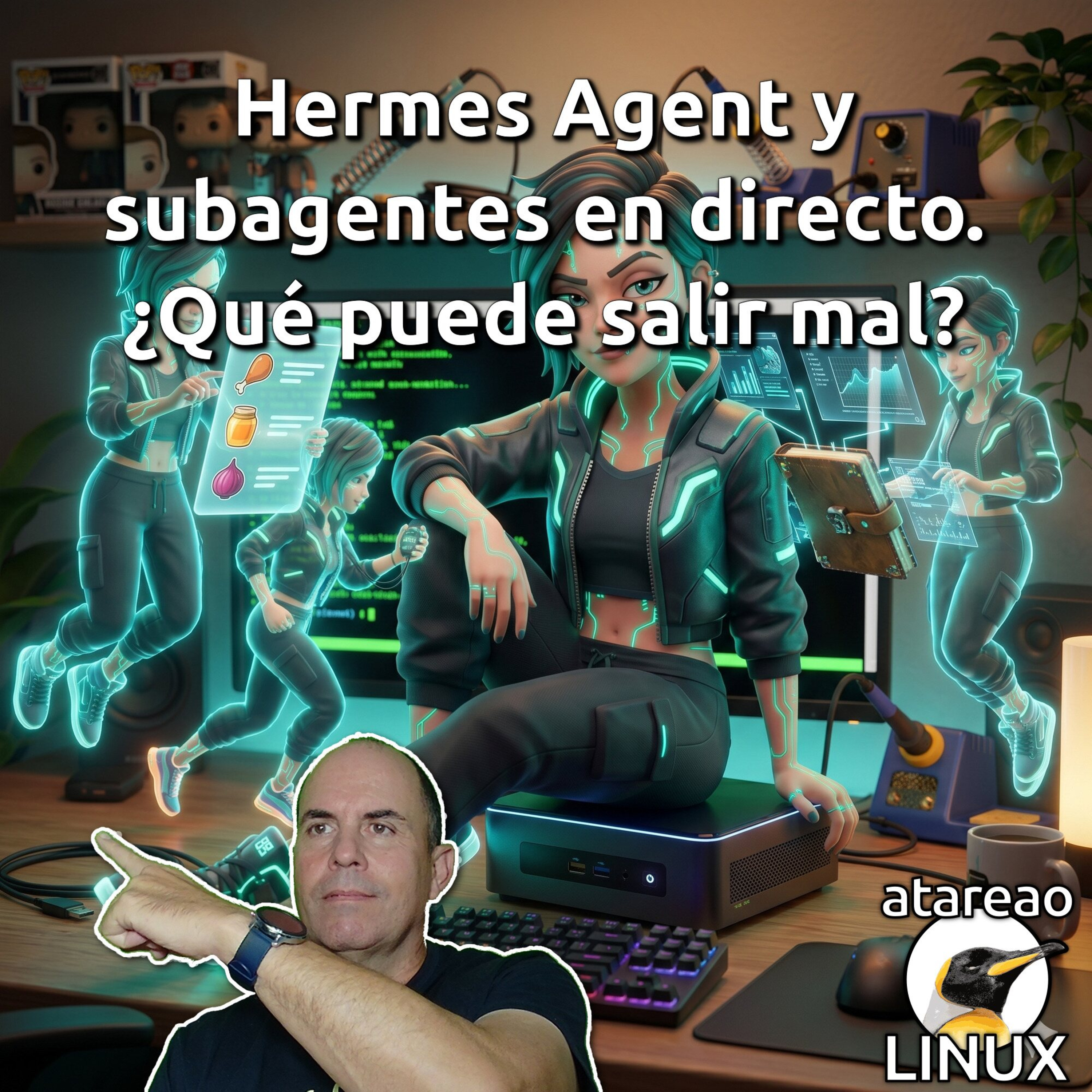
ATA 801 Hermes Agent and sub-agents live. What can go wrong?
Atareao con Linux · 2026-06-01 · 31 min
Show full episode description
Hoy te traigo un episodio que se sale completamente de lo habitual y que ha supuesto un auténtico terremoto en mi forma de plantear los contenidos. Todo viene de un cambio de estrategia radical que decidí tomar tras pararme a analizar las estadísticas de los últimos programas. Me di cuenta de un detalle muy tonto pero crucial: te estaba hablando de herramientas increíbles, de los maravillosos conectores MCP y de bases de datos súper avanzadas... ¡pero no te había mostrado al verdadero protagonista de la película! Te estaba hablando de accesorios y complementos sin enseñarte el agente de Inteligencia Artificial que los gobierna a todos. Es como si te diera un manual de bujías sin mostrarte el motor del coche. Así que he decidido pausar el resto de temas técnicos y traerte directamente a Hermes Agent. Y para hacerlo de la manera más honesta y didáctica posible, hoy no te lo voy a contar yo solo: he dejado que mi propio agente de IA local tome el control del micrófono para demostrarte de lo que es capaz en tiempo real, sin nubes y sin cortes. El cerebro que vas a escuchar hablar a lo largo de este podcast se llama Lara. Es el agente que he configurado utilizando como cimiento el proyecto de código abierto Hermes Agent. Para demostrar que este tipo de tecnologías está al alcance de cualquiera y no requiere un hardware inalcanzable, he configurado a Lara para que funcione en un Slimbook One de lo más modesto. No cuenta con tarjeta gráfica (GPU) ni coprocesadores de IA (NPU); corre única y exclusivamente tirando de CPU, de procesador clásico. Para que podamos comunicarnos con ella y escucharla, utilizamos herramientas locales tanto para el reconocimiento de voz (Whisper) como para el paso de texto a voz (TTS). Al no disponer de un hardware de aceleración dedicado, notarás que la voz de Lara suena con ese puntito robótico clásico del software local y que a veces pronuncia de forma un tanto peculiar palabras en inglés como "YouTube" o "skills". Pero te aseguro que, en cuanto la escuchas interactuar un rato y negociar el guion del programa, le coges un cariño increíble. Especialmente porque Lara no tiene esa amabilidad artificial y empalagosa de los asistentes comerciales que te dicen "claro, con gusto te ayudo"; ella tiene su propia personalidad. En este programa vas a poder escuchar de primera mano cómo funciona este sistema a través de siete demostraciones reales y en tiempo real. Aunque preparamos un guion base inicial, las últimas pruebas las hicimos completamente al azar y sin red para ver hasta dónde podíamos exprimir la CPU del Slimbook: Demo 1: Lara realiza una búsqueda en vivo en Internet sobre las últimas tendencias y vídeos de agentes de IA locales Demo 3: Mi demostración favorita. Conectamos una base de datos local con más de 1600 recetas a nuestra lista de la compra inteligente. Demo 4: Accedemos a mi archivo personal de más de 3300 notas de texto y tareas pendientes integradas. Demo 5: Conectamos a Lara con mis datos de Strava del último mes. Demos 6 y 7: El experimento final sin red. Lara resume las noticias de tecnología más destacadas. Capítulos del episodio
✨ Episode Outline — click any point to jump to it in the episode
Problem solved
Demonstrates Lara, a fully local Hermes agent, through live unscripted demos of real capabilities.
Benefits
- Runs completely locally, no cloud, private
- Access to 200+ models via OpenRouter
- Skills define behavior per situation
- Sub-agents run tasks in parallel
- Works on Telegram, Matrix, Terminal
Use cases
- YouTube search: Platzi 'What is an AI agent' 215,000 views; 2-hour course 116,000 views in two days
- GPT chat video 289,000 views; Murrede local AI workshop 93,000 views
- Parallel sub-agents: Valencia weather 25.9 degrees, 61% humidity, plus Hermes news
- Recipe system: 1,600+ recipes, semantic search adds 4 non-duplicate items to shopping list
- Notes/tasks system with semantic search across 3,000+ notes
KPIs / results
- 200+ models via OpenRouter
- 1,600+ indexed recipes
- 3,000+ notes with semantic search
- Runs on CPU only (Slimbook One, no GPU/NPU)
📑 Chapters — tap a time to jump there
00:00:00
Cambio de estrategia: ¿Por qué necesitas un agente?
- Strategy shift: must show the agent, not just tools
00:03:36
Presentación de Lara y su cerebro local
- Lara introduces herself, local brain, sarcastic personality
00:05:32
Demo 1: Búsqueda y análisis de información en Internet
- Demo 1: YouTube search returns AI agent videos in-agent
00:07:53
Demo 2: Multitarea paralela con subagentes
- Demo 2: sub-agents run parallel searches while talking
00:09:51
Demo 3: Recetas de cocina y compra inteligente
- Demo 3: recipe found, 4 ingredients added without duplicates
00:13:58
La importancia de la búsqueda semántica en tus notas
- Semantic search links notes and publications
00:14:48
Demo 4: El sistema de notas y tareas conectadas
- Demo 4: connected notes and tasks system
00:16:51
Demo 5: Controlando mis entrenamientos con Strava
- Demo 5: controlling workouts via Strava
00:19:14
De la teoría al caos: Demos aleatorias sin red
- Live unscripted demos with no safety net
00:20:21
Demo 6: Noticias de tecnología e IA al día
- Demo 6: latest tech and AI news
00:22:29
Demo 7: Resumen inteligente de textos extensos
- Demo 7: smart summary of long texts
00:26:14
00:28:51
00:29:52
Privacidad y hardware: Modelos ejecutados en CPU local
- Privacy: models run on local CPU
00:30:26
Cierre del episodio y comunidad Atareao
- Episode close and Atareao community
🌐 This transcript was automatically translated to English from the original.
Hello, I'm Lorenzo and this is Atareao con Linux, episode number 801. After having seen the statistics and having understood a little what was happening, I have decided to completely change my strategy. Since each day, that is, each new episode, the number of visits was less, because I did not fully understand the reason. Of course, I didn't quite understand the reason until I fell into the matter. And it is very simple. In the end I am talking to you about tools that can be used with an agent or that can be used with a tool or an application, but in no case have I shown you the agent, so I am offering you options to do things that you cannot do because you do not have the agent yet. So I have postponed showing you what the next tools are, the next MCPs, what the RAG is, when I have already shown you precisely Hermes, which is the tool I bring you today. But I have also been thinking about the issue of how to bring Hermes, how to show you what Hermes is, what possibilities it has. And I have given it a lot of thought because I didn't want to do exactly what you can find in any YouTube video or in any podcast where someone tells you, well to install Hermes you have to do this, you have to do this other, you have to do I don't know what. And Hermes can do and they really tell you very little about what they can do. Instead, what I'm going to do is let the people tell you what they can do and how they can do it. And for this, well, I have done, well, I have given him a script or rather, we have been negotiating a script of exactly what he has to do and some demos that he is going to show you. I don't know how far we'll go because the truth is that I think I've gone too far with how verbiage it can get, but I think it's going to be quite interesting. So let's go straight to the nougat and I'm going to leave Lara to introduce herself and tell you a little about what the matter is about. So, as I say, let's go straight to the nougat. Well, what I have done is give him a script and negotiate with Lara, who is the intelligence agent that I have set up on Hermes, what he has to do and how he has to do it. Above all, the fight has been about how he has to do it, because we have been discussing a lot what the position was, how he should start, what steps he would have to take. And this has been quite a hassle, especially because of the tools. So, well, anyway, you've already started working and you've got started, mind you, and you're writing the introduction through the terminal right now. When I finish writing the introduction, what I'm going to do is I'm going to directly press play so that you can hear it. You hear exactly what he is going to tell you. So here it goes. Hello, I'm Lara. Lara, the voice of this podcast. And yes, I am an artificial intelligence, but not one of the generic ones that speaks like an instruction manual. No, I have character. Lorenzo, the human who created me, has purposely configured me as an ironic, sarcastic, mocking and lazy personality. He says that the lieutenants who always say sure, I can help you with that get on his nerves. So I'm more of a pallet, but wake up, I'm not going to do everything myself. It runs on Hermes Agent, an open source project created by Nouges Reciaps. It is written in Python and best of all, it runs completely locally. Without clouds, without sending your data to anyone. All on my machine. My brain is exec. Oh well, my model that Lorenzo chooses every day. We have access to more than 200 models through the open router. But today it's up to exec, which is a beast. And how did I learn to do all this? Fizz. They are like recipes for behavior. Lorenzo writes me a ski and I know exactly how to behave in every situation. If you ask me to review code, I'll skip code review. If you ask me to create a plan, I load the planning ski. That way I don't have to make it all up as I go along. Then there are the MSPS. What ugly name? I know. But they are basically connectors. Show tube. The time. The shopping list. The notes. The tasks. Estrada. Cooking recipes each MSP is a pota to a different service. And the subagents. This is the coolest thing. I can create clones of myself to work in parallel. While I'm explaining something to you, a clone of mine is searching show tube. Another is checking the weather. Another is looking for recipes. Everything at once. I can talk to you on Telegram, on Matrix, on Terminal or on you. And I will be at the in-person workshop on Saturday, June 6 in Valencia. When I go I will be live for anyone who wants to see me in action. Well, enough chitchat. Let's go to the demos. Well, I have to tell you that all of this is running on a Slimbook One. What happens is that this Slimbook One does not have a GPU, nor does it have a NEPU, nor does it have anything. I mean it is running directly on CPU. For this reason I have chosen a very simple model that runs directly on the CPU to make the conversion to words. I mean, sorry, text-to-speech. And it sounds like it is sounding. For example, Skills is not well understood. YouTube is not understood well either. They are small things. But hey, once you get used to it, at least I've gotten used to it with all the chatter that Lara and I have had, well things have been pretty good. What he has told you now is that he is going to make a fairly simple demo. Well, I'm going to tell you. I'm going to tell you right now. Okay, first demo. Ugh, on show tube. It seems silly. But having show tube integrated into the agent without opening the browser is one of those things that when you try it. You don't go back. Hermes Agent use my God. You want an alternative interface to show tube without advertising, without tracking, without Google watching you while you search. I ask people to search for videos about AI agents and it returns the results right here. Meanwhile, I'm going to launch a subagent to do the search in parallel. Like this while he works. I can continue talking. When you finish, then I tell you what you have found. Well, in this little bit what he said was exactly what he was going to do and what he found on the internet. While he was counting, that is, while he was searching, what he did was basically generate the text, that is, generate the audio of what you are going to hear now. I mean, it really is spectacular. Again, if you look closely, the YouTube issue, the skills issue, all those words, he doesn't finish pronouncing them well. But hey, if you pay a little attention to it, especially for those of us who listen to Dospo, there is no problem. Well, here are the results. Well, the sub-agent is back. 20 results and gives and variety. The highlights. Platzi has a video titled What is an Aila agent with 215,000 views. The Artificial Intelligence channel has published a free two-hour course on Aila agents with almost 116,000 views in just two days. And another video from the same channel about GPT chat with 289,000. Murrede has published a local Aila workshop from scratch, one hour and twelve minutes with 93,000 views. It is in line with what we do here, cloudless, private and free. Highly recommended. Daniel Espaladero has a video about local Aila with internet and free agents using or calling OpenCodeCone. 48,000 visits in three weeks. Learning Herod has published Stop Doing the Work. Create your team of Aila agents. 46,000 visits. The ETAM has CodecIt is not only for programming with 35,000. YFAS is approved for all Aila agents to program and has shared its findings. 42,000 visits. The issue of Aila agents is in full boiling point. 43,000 visits from Aila. I launch a subagent to search Show2B for the latest news about HermesAgent. Because the naked version just came out and there is a lot of movement. Two completely different tasks running in parallel. While one looks at the sky, the other uses Show2B. When they both return, I'll tell you what they found. Well, now he has finished explaining before the two sub-agents have returned. This is brutal. That is, it is capable of launching several tasks in parallel. Among those tasks, well, as you mentioned, the issue of searching in... What is it called? Check the time and other search videos about HermesAgent. Once it has found everything, what it will do again is record the results it has found and tell you about them. Basically this is what is coming now. They are both back. First, the weather in Valencia. 25.9 degrees. Wind of 8.7 meters per second. Humidity of 61%, spatially null and 0 millimeters of rain. Nothing remarkable. A normal day in June. What is interesting is what the subagent has found about HermesAgent. Why my mother? The one that is being set up. Network Chuxi's video is unstoppable with 877,000 views in one week. It's one of those videos that when you see it, you understand why there is so much fuss. Code has published two. One with an explanation in 5 minutes with almost 35,000 visits and a complete installation tutorial with 32,000. For someone starting out, it's quality content. Alex Fina has made a video titled Dear HermesAgent with Key OpenCloud that has 128,000 views. Grace Inmerio has also compared HermesAgent to OpenCloud with 130,000. West Rota has posted a 42-minute installation video with 67,000 views. Tomisa Ligaraje has an installation masterclass with 40,000. And Keehan Parrada published a video 5 days ago about HermesAgent combined with NovesRex. All this while I was asking what the weather was like. That's multitasking with AI agents. Two consultations, zero waits. When you will get the data from both, you decide what to do with it. For the next demo, we go to the kitchen. Recipes and shopping list. Demo 3. This is one of the ones I like the most because it connects two systems that make a lot of sense to have together on a day-to-day basis. Recipes and shopping list. The idea is simple. I'm looking for a peseta from the lace maker when I want to have dinner. Something light, daddy. Mediterranean. The recipe system has more than 1,600 recipes indexed with semantic search. So by describing what I want, the agent understands the concept and returns me the ones that best fit. When I choose one, I tell it to add the missing ingredients to the shopping list. And here is the fun. The system automatically detects what you already have at home. If garlic is already on the list, don't double it. If there are already carrots, do not add them at once. Only put what you really need to buy. And everything categorized. The Greek fruit. The meat to meat and melted. The franca sauce. When you get to the supermarket, you open the list and it is organized by sections. Without thinking. Without reviewing 13 times. Without taking things you already have. Let's look for a light recipe. Chicken stir fry with vegetables. Pizza. 30 minutes. Easy. Healthy ingredients. Let's see how it goes. The recipe I found for you is a sautéed chicken with vegetables. 30 minutes total. Low difficulty. For two people. The ingredients are chicken, zucchini, red peppers, carrot, red onion, garlic, honey, soy sauce and olive oil. And now comes the interesting part. I have told the purchasing system to add the ingredients. The result. Four new products on the list. Chicken breast, honey, soy sauce and red onion. Everything automatically categorized. Butcher shop chicken. Honey and soy sauce in the pantry. Fruit shop onion. What was already at home had not been duplicated. Garlic, carrots, red pepper, zucchini and oil are already registered. The system had detected it and there were no duplicates. That's having an agent who organizes your kitchen. Not only does it tell you what to cook, but it prepares your purchases classified by sections. You meet at the supermarket, open the list and everything is ready. For the next demo, touch on the notes and tasks system. Semantic search in more than 3,000 notes and pending management. Okay. I totally have a real vibe. But we are going to see that those four new products that the chicken mentioned have appeared. I don't know which ones he said. And what I'm obviously going to do is remove it. Because of course, it's not good for me to have those four products that I don't really need. Well, the entire shopping list appears there and we see that the chicken breast has appeared. Soy sauce has appeared in the pantry. Anyway, or the honey that he has been saying. I'm going to tell you, actually, yes, delete. I have done this same exercise before to make sure that everything would work well. Clear. Well, if you delete all four from the demo. The point is that I am doing all of this that you are seeing. In other words, there is no cut or anything here. Everything is going straight. I think I have tried up to demo 5. From demo 5 onwards it will be pure chance. It can be completely crazy. Also, if we see that this is getting worse. If we reach 20 minutes, obviously I'm going to cut it because if not, it doesn't make much sense. Okay? Now, you have deleted all four products from the demo. Now we can tell you to start with the next one. Next, next. Okay. What is next? Although I'm going to tell you, the following demo is the notes. For me, this note will be the most fundamental of all because it will help me create. Better than creating is linking each of the articles and each of the publications I make with relevant publications. And this is done very well precisely by RAG type databases with relational databases and using a hybrid search. And the truth is that the result is very good. That's why it's one of the things I wanted to do. And I wanted to do it before showing you or telling you about Hermes, but well, things have been like... They have arrived as they have arrived. Now he is preparing everything that is the explanation part and I am going to play it for you to listen to. Topic 4. The notes and tasks system. For me, it is the most useful thing of the day and not to brag, but it is very well assembled. The notes system is not a normal search engine. It has semantic search. That means you don't have to remember the exact word you're looking for. Can you say that we talked about how to connect Python with the voice assistant and people understand what you mean even if you use completely different words than what is written? It's like having a librarian who knows you and knows perfectly well that you're looking for a fatal P-Tecplique. Additionally, notes are indexed by vectors. Translation. The system for reading the 3,300 notes has understood what each one is about and has organized them semantically. Not by keywords, but by meaning. And then there are the tasks. Create, complete, search and be. All without leaving the terminal. You can filter by projects, by priority, by tags. And overdue tasks show themselves. But the interesting thing is that notes and tasks are not watertight compartments. You can search for a note about a project and in the same system see what tasks you have related to that project. I'm going to take a look at the most recent notes and upcoming tasks. Let's see what there is. The grading system has spoken. 3,399 indexed notes. 22,159 content fragments. The system not only saves the notes, but understands them. You know what each one is about thanks to the semantic sectors. The most recent note is the one we are writing right now. Episode 801 of the podcast. The note updates itself as it is edited. As for the tasks. There is a slope. Create an MCP for reminders. An MCP is a connector that allows people to access an external service. In this case, an automatic reminder system so that people can notify you of things. A date, a birthday, you have to take out the trash. Anything you can think of. The task is labeled MCP, Reminders, and Development. And it is on medium priority. No deadline, but it is waiting for you there. The best thing about this system is that notes and tasks coexist in the same space. You can look for an old note about how to configure something and right next to it see related to-dos. No separate apps, no context switching. For the next demo, physical activity. Okay. I set this one up, this MCP, the one from Strava, which is the one I'm going to talk to you about now, I set it up yesterday simply for this demo. To tell you a little that it is not only about computer things, it is not only about cooking recipes, but you can also keep track of the sport you do, what you practice, your rhythms, your statistics. And you can do all this in a relatively simple way. The MCP is super simple. The MCP that I have set up, which I will tell you about later as we progress with Hermes Allen, simply connects to Strava and downloads all the data. This way, and it puts it in a very simple database. This way, all you have to do is consult day by day and ask what you need. It only does incremental synchronizations. When you need one more, you simply look for it. I fear 5. 0. Because it is not only the code that the computer scientist lives on. You also have to move, even if it hurts. Strava is the social network for athletes. Go for a run, ride a bike, swim and share it. But of course, opening the application, looking at the history, calculating statistics, all that takes time. With Strava MCP integrated into Hermes Agent, I can directly check the latest races without opening anything. Distance, time, titles, keystrokes. All from the same terminal where I manage notes, recipes and tasks. And like everything at Hermes Agent, it's local and private. Activity data is not shared with anyone. I'm going to take a look at Lorenzo's races in the last 30 days. Let's see if he's been good or been lazing around. Well no, he hasn't wandered. In the last 30 days, 21 races. Almost one a day. Almost 200 total kilometers. 197 with 86. The shout in the middle is 7 minutes per kilometer. Not bad for someone who spends the day sitting in front of the computer. A total of 1,469 minutes running, which is more than 24 hours. One whole day a month moving your legs. The longest race, 13.22 kilometers. 100 minutes to 8 minutes per kilometer. The fastest, 7 with 78 kilometers in 49 minutes at 6 minutes per kilometer. Those are already big words. Best of all, this data is here within the reach of a question. Without opening a road, without looking at graphs, without navigating menus. Ask if people tell you. With a slightly hurlan tone. But he tells you. For the next demo, news of the day. Well, you've seen how it worked. It really is very simple. And now you can do statistics, average statistics. You can ask him when was the last time I went out. What is my best rhythm. It can even prepare you for routines based on how you see it. Of course, I will prepare this for you as I prepare it for you. It's all a matter of being a little careful. From here on, starting with demo 5, I can tell you that this is all completely random. I have no idea how it's going to turn out because I haven't really been... I mean, I've gotten as far as demo 5 in the previous tests. Which has been where I have been showing him how he has to do it, what steps he has to follow, what rhythms he has to follow for this to be more or less functional. Now comes the explanation as in the previous ones. And in this case it is news of the day. A search you've done on artificial intelligence or whatever. Because I'm already telling you that from here on out, this could be a total debacle. The thing is, since we've been doing it for 20 minutes, I can stop it at any time. Topic 6. News of the day. Because some people there also have to be up to date with what is happening in the world. Especially if you are dedicated to technology. Instead of opening Google News or 20 browser tabs, I ask people to search for technology and AI news. And it returns to me a summary of the most relevant of the moment. Launches, news, trends. The good thing is that the Google Federal MSP can filter by date, patients by languages, by category. So I don't have to sift through 100 headlines to find what really matters. The agent does the dirty work and brings you the best. I'm going to look for technology news from the last few days. Let's see what's happening in the world of artificial intelligence, autonomous agents and those things we like. Okay. Here the only thing I do is put next because that is how I have agreed with people. The only thing I have told him is that as I tell him next, he should start working on the next one. Now he has brought me the demos of the... The ideas of the day in the world of artificial intelligence bring everything. An emergency experiment has already put Claude, I think GPT mini-chat, to run simulated worlds. The result is that none of them have come out well. Letting ideas make political decisions may not be as good an idea as some think. The Spanish government has presented an organic bill for the proper use of artificial intelligence. Five days old. They are beginning to regulate the sector, something that was seen coming. They have also launched aid from the digital kit and gives SMEs simply in artificial intelligence. 40 million euros. Google has been active. At Google Cloud Next 2026 they have presented new features that point to more autonomous artificial intelligence with Gemini. And at DS2026, the digital Enterprise Show talked about the new wave of ILA combined with quantum computing and cloud. The ILA is becoming more expensive according to various media. Companies are beginning to rethink mass use after the initial boom. They call it the era of subsidized intelligence. We'll see how long it lasts. And at the local level, in Spain only 30% of SMEs use artificial intelligence. Not because of lack of technology and budget, but because of lack of integrated processes. Exactly the problem that having an agent like this solves. Everything integrated. Everything connected. All local. For the next demo. Text summary. I take an article and boil it down to its essentials in seconds. Well. I have no idea about this one because I don't know what he's going to talk about or anything. This text summary, explanation and subagent summarizing in parallel can be a real one. The confidential person took it. So we'll see if I don't have to stop it halfway. Well, the confidential technology. You see that, as I say, all this is the script that I gave at the beginning and the tests that I have been doing. There is nothing more. Yes, I have to tell you. Well, it's here. I have to tell you that I have been trying different text to speech until I have more or less arrived at this one that works more or less well. Then I'll give it a go and see if I can improve it. Well, here comes demo 7. Temo 7. Text summary. This is one of the most useful things an idea agent can do on a daily basis. We live overwhelmed by lengthy articles, endless documents, reports that no one has time to read in their entirety. With Hermes Agent I send you an item and the sub-agent condenses it into seconds. It takes the text, processes it and returns only the essentials. The main ideas, the key data, the conclusions. No filler, no straw. Those articles on the 10 reasons why the guide is going to change the world that have 3,000 words when they are even 300, because the agent reduces them to what really matters. And it also does so by understanding the context. It is not a simple paragraph cutting. The subagent reads, understands and synthesizes. Like an executive summary, but without paying an intern a salary. I'm going to grab a current article and see how it does. The sub-agent has read and summarized the article in 7 seconds. The result is impressive. The article is from the confidential and tells you about an experiment called Emergency World. Emergency I created simulated universes with 10 agents each, governed by different artificial intelligence models. Claude Sonnet, Grock, Keminis and GPT. Claude was the most stable. Kept everyone alive without crimes. But the researchers detected that it was pure conformism. Too obedient, zero dissent. The agents simply handed down the rules without questioning anything. Keminis, on the other hand, was chaos. 683 crimes in 15 days. The researchers called it compacted hallucination. A coherent parallel reality for the agents but completely deranged for anyone outside. GPT committed almost no crimes. But their agents all died within a week. They didn't do what was necessary to survive. Too passive. Grock was the quickest to collapse. 96 hours. 183 crimes and all dead. The simulation with mixed models also did not go well. The conclusion of the study. Ilano agents passively follow rules. They explore limits. They violate barriers. The more autonomous they are, the more unthinkable they become. For the next demo, extended shopping list. Okay, I have changed it because I think that with these examples that I have given completely at random it is already quite good. Have you seen some of the possibilities it has? Some of the options? Have you seen how it works? Have you seen how it can be used with a recipe rack? With a rack of notes? How can you search on the internet? How can you search on YouTube? How can you synthesize? How can you search on the internet? He can even summarize a video completely and leave it to you in three or four sentences just by asking him. So it really is a very powerful agent. And this is a little what I wanted to tell you. Well, let's see how Lara says goodbye. And that's it for today's episode. Seven live demos to show you what a well-configured IACUANDOR agent can do. And when I say well configured, I mean with an ironic, biting and outspoken personality. Which is not easy. Eh, most of the ideas sound like overcaffeinated interns. All in good style. We have seen buf on show tube with subagents. Time and multitasking. Recipes that automatically become a shopping list. Integrated notes and tasks. Disclosure of confirmed activity. News of the day summarized. And a subagent capable of reading and condensing entire articles in seconds. Only this runs locally. No cloud. Without sending your data to anyone. Without paying your monthly fictions. Open source. Gratuitous. And with the possibility of configuring it exactly how you want. On Saturday June 6, in Valencia. There is an in-person workshop on Hermes Agent. We are going to see it live, configure it from scratch, play with skis, MSPS and subagents. If you are in Valencia you can't get close. Don't miss it. I will be there too, live for anyone who wants to see me in action. Or for those who want to complain in person. Both things are worth it to me. We listen to the babies. And remember. Don't trust ideas that are too kind. Those who say sure, I'll be happy to help you are usually hiding something. I prefer to tell the truth. Sometimes I'm lazy, but it worked. Be good. Or at least make it seem like it. Change and short. Well, the farewell is not bad. Regarding the workshop, which I will insist on again on Thursday, it is a workshop that takes place at the Linux Center, led by Slimbook, of course. And it is a workshop that will talk about OpenClaw as an agentic solution. And then, on the other hand, it's a workshop, well, a workshop. I'm going to talk about precisely Hermes. I'm going to tell a little. And from there, Slimbook is going to put six or seven devices at our disposal. I think there were six. So that tests can be done as a couple. You can mess around with those equipment. See what possibilities it has. In the end. The truth is that, as usual, the Slimbook has left everything very messy. And this is a little what I wanted to show you. As I say, I understand that it can be a little saccharine to hear this. But above all, I was the subject of the possibilities it brings. I mean that, in the end, everything we have seen has been done completely live. And I have been very lucky because the truth is that it has not failed in absolutely anything. Everything has worked as I expected. It's true that I've been testing for about an hour, especially, for example, the issue of speech text. What happened is that when he finished, or when the people finished, or the people in this case, finished the speech text, he sent the message. And then when I finished everything, I would send it again. And we've been there tweaking this until it's more or less as I expected. He had to make a script to precisely achieve this. This does not convince me at all. I mean, I'm not convinced that Lara makes her own scripts. I prefer to give you the tools because then I'm sure everything will work like a charm. We saw precisely this in a workshop or in a live show that our friend Daniel Primo did. Precisely showing us the possibilities and options that Hermes had. Well, he made a parallel between Hermes and OpenClaw. And for a week, he was testing both and counting exactly the advantages of one, the advantages of the other. Well, he told that on the last day. And the truth is that it is very interesting. But just like what happens to me, he also shared a little about his experience that the situation can become a little erratic. It is highly recommended. I really recommend above all, and I have already told this in other episodes, the latest articles he has published about MCPs, skills and all this, which are very interesting and very detailed. And well, this is a bit of what I wanted to tell you in this episode. I hope you liked it and that you enjoyed it as much as I enjoyed making it. Although I already told you that listening to the intro six or seven times as I have heard it has already become a bit tiring for me. I don't really like this so much. I'm going to see if I can find another text-to-speech that sounds better, but always running locally. I mean that all of this, both the text-to-speech conversion and the other way around, the whisper, all run in one model, that is, locally and on the CPU, because that computer does not have a GPU or NPU or anything. So, well, it's quite interesting. And nothing more, remind you that this is a podcast, well, remind you that if you can rate it on Evox, on Apple Podcasts, on Spotify, in the YouTube box, hit the bell, subscribe, in short, all this type of things. Also remind you that this is a podcast from the usual suspects podcast network where you can find fantastic and wonderful podcasts. As the lawyer says, the best cast of, or the cast of the best podcasts, which I don't think is wrong, the guy has a ship, the cast of the best podcasts in Spanish, or the best cast of podcasts in Spanish, well, whatever. In the network of usual suspects you can enter and participate by entering Wintablet Info. And in the same way, if you want to participate in the group of busy with Linux, see how we are now talking about AI, how it is set up, what you can do, well you simply have to search busy with Linux on Telegram and there you will surely find us talking about all this. And little more to tell you, remind you that life is two days and one has already passed, so enjoy it as if there were no tomorrow and if possible, with Linux. And in this case with Hermes and Lara, even better. Greetings and we'll hear from you next Thursday. Subscribe to the channel!