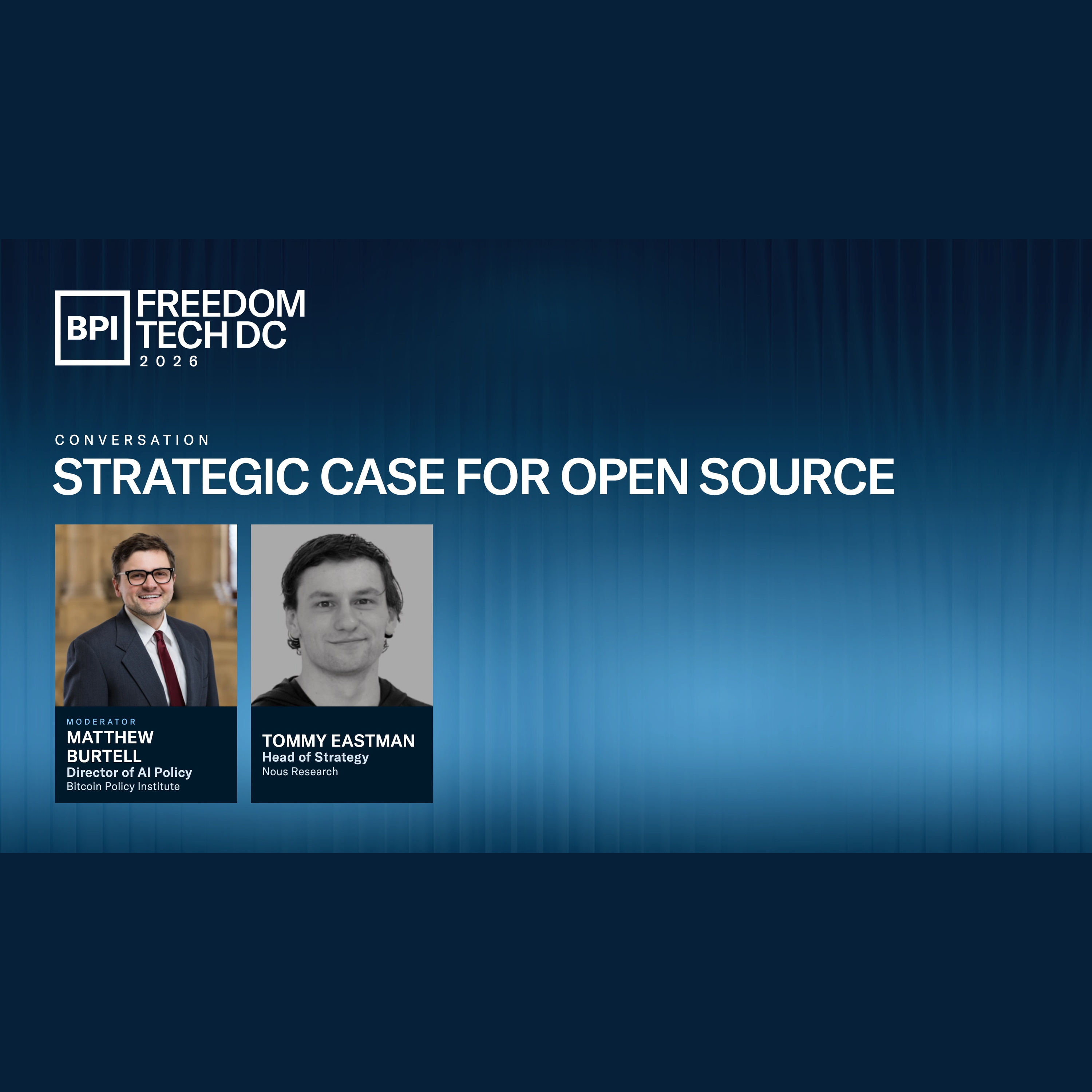
Strategic Case for Open Source | Freedom Tech DC 2026
Bitcoin Policy Institute · 2026-09-29 · 19 min
Show full episode description
Tommy Eastman joins Matthew Burtell to discuss the strategic case for open source AI and Nous Research’s Hermes Agent. They explore control over data and models, competition and costs, distillation, and the policy choices affecting open AI development. Recorded during Day 1 of Freedom Tech DC 2026, September 22, 2026, in Washington, DC. Presented by the Bitcoin Policy Institute. SPEAKERS Matthew Burtell — Director of AI Policy, Bitcoin Policy Institute; moderator Tommy Eastman — Head of Strategy, Nous Research LEARN MORE Freedom Tech DC: https://www.btcpolicy.org/summit Bitcoin Policy Institute: https://www.btcpolicy.org/ Matthew Burtell — BPI: https://www.btcpolicy.org/authors/matthew-burtell Nous Research: https://nousresearch.com/ FOLLOW ON X Matthew Burtell: @MattBurtell — https://x.com/MattBurtell Tommy Eastman: @yeahfortommy — https://x.com/yeahfortommy Nous Research: @NousResearch — https://x.com/NousResearch Bitcoin Policy Institute: @bitcoinpolicy — https://x.com/bitcoinpolicy SUBSCRIBE ON YOUTUBE Bitcoin Policy Institute: @btcpolicyorg — https://www.youtube.com/@btcpolicyorg ABOUT BPI The Bitcoin Policy Institute is a nonpartisan nonprofit advancing Bitcoin policy through research, education, and engagement with policymakers. #FreedomTechDC #BitcoinPolicyInstitute #OpenSource #NousResearch #AI
✨ Episode Outline — click any point to jump to it in the episode
Problem solved
Why open-source agent harnesses and open models matter for data sovereignty, cost, and avoiding lock-in to closed AI labs.
Benefits
- Own any part of the stack: agent hosting, trajectory data, or inference
- Model-agnostic harness avoids vendor lock-in and price hikes
- Open models deliver most tasks at a fraction of closed-model cost
- Protects proprietary data from labs that could train competitors on it
- Supports small businesses and US open-source competitiveness versus China
Use cases
- Hermes Agent turns a chatbot into long-running agentic workflows with memory and skills
- Enterprises swapping closed models for open models after 'token maxing' bills spiked
- Small businesses using open models for cheap agentic outcomes
KPIs / results
Tools / build
- Hermes Agent (Nous Research open agent harness)
- Open-weight models post-trained by Nous (Llama era)
- Agent tools: browsers, image generation, memory, skills
My name is Matt Bertell and I am the Director of Special Projects at the Bitcoin Policy Institute and today I am joined by Tommy Eastman of Nose Research Thanks Matt, good to be here Alrighty, Tommy, for the uninitiated, what does Nose Research do? So you're an open source agent harness company, what does that mean? Yeah, so Nose is an open source AI lab, we have a long history of post training models back when Lama models were state of the art a few years ago we would post train them focused on creating more pliability, more flexibility, making them more human-like so that when you shadow with them it didn't sound like you were talking to a robot necessarily but you could feel like you were talking to a person we've gone down a few different research rabbit holes since then which I'll fast forward through but get to in February we launched Hermes Agent which more people actually know us for Hermes Agent nobody ever knows when I say I work at Nose what that is but you say Hermes Agent and they know Hermes Agent is an agent harness and what a harness is, is the it's really the scaffolding that allows you to go from to make the jump from a normal like chat bot that you're just interacting with in a terminal like ChatGPT to actually doing things that have agentic outcomes so that's long-running tasks it has a memory system it continually learns new skills so that you can do things reproducibly but it basically is all of the plumbing that takes you from you know a user interacting to the actual model, the LLM itself and then all the tools that the agent needs to be able to do stuff in the real world like browsers, image generation, that sort of thing very nice, very nice and on so there are all sorts of harnesses and you, your product is an open harness right, you have 250,000 or so stars on GitHub what, what, what, why does the open part of an open source harness matter here? Yeah, I think it's really important I think we've cared about this deeply for a long time the openness at the harness level I think you've seen everybody start to care about it in the last four or five months since Alex Karp kind of did that he did that, that speech, that spiel on the value of owning your own AI stack and the data sovereignty associated with that so we've seen it happen where people, where enterprises use these big labs for their inference they're giving all of their data to these labs they're kind of secret sauce, right and then the labs, the labs can train on that and build competitors you're giving that, you're giving that stuff away, right an open harness, there's, there's two big pieces of value from the open harness one, it enables you to own whatever part of the stack you want whether it's where the agent actually lives whether it's the data, the trajectories that are produced from your agent or it's the inference itself, right which again kind of holds that, that secret sauce so open harnesses allow you to do that they allow you so that you're not locked in to a specific vendor, right so if a vendor, if one of these model companies increases prices or if a different model company has a much better model with an open harness, you're not locked in it's, it's completely model agnostic what that enables to, which is becoming increasingly more important I think in January, February we saw CEOs saying you know, I want my, I want my employees to token max token max, token max, use tokens well then they, like the bills came in, right and they were like, okay, this was, this was not smart we're, we're spending tons and tons of money and I don't know what's happening with it and so open harnesses allow you to use open source models which, that's where the free market actually exists, right you're, we have much better price discovery these open models are now at the point where I like to say, a huge percentage, let's say 90% of people that use AI today 90% of their tasks can be done with open models with a great success rate at a fraction of the cost of, of closed models so the open harness level really allows, enables you to do those two things it enables you to own whatever part of the stack you want and protect your data and also enables you to capitalize on the, the market effects of, of open models something you said there on the, sorry yeah, the difference between closed and open here got me thinking you guys are like situated in an interesting part of this AI stack, right you, you serve both, excuse me, not serve but, Hermes agent is compatible with both closed and open models so, one thing that I wondered about, you know, so you mentioned this sort of yeah, 90% of tasks can be completed with open models how do you see the sort of the, the future, the trajectory sort of shaping and the relationship between big closed providers and the sort of distributed open, really the world yeah, it's, it's, it's really interesting and you're seeing the, the past few months have been a massive point of change for this the, right now we're as close as we've ever been as far as open models versus closed models closed models are still ahead like everybody, nobody really disputes that but open models through, you know, distillation in a big piece and also technological innovations open models have closed that gap really, really quick, really, really quickly I think what's very, what's becoming very clear is that intelligence is becoming commoditized applications is where value accrual is happening tell me about that, I want to hear more about this yeah, yeah, that's where I love why, you know, where, where Hermes agent sits, right it's, it controls the relationship between the user and this, and this intelligence I think large labs are realizing that like the large closed labs are realizing it I think it's a big part of why the, the true frontier is not, is not accessible to all users right now, right like the true frontier models, mythos it's, I mean, there's a lot of discussion around the safety of it, etc. but they are being used with in very specific situations where I think these companies think that they have strategic value doing frontier research with, with enterprises that, that's a much larger path to profitability a much larger opportunity than selling tokens to, selling tokens to retail so I see a, forward looking, I see a bifurcation between what's publicly available and what's available via, you know, specific, specific bespoke deals with labs and, and enterprises I don't see a gap reopening between like publicly available closed models and publicly available open models I think distillation is basically impossible to prevent it's certainly impossible to prevent globally it may be possible to prevent in the, in the, in the West but it is not possible to prevent globally and so I think you're just going to see a, a very clear convergence on open and closed models and the commoditization of that intelligence but I think we'll continue to see a gap whether it's a three month lag or a six month lag or a year lag between what the closed labs have as, as kind of the frontier intelligence and what you or I could ever access Yeah, yeah, and so, something interesting to pull on here is this, the question of internally deployed models that, you know so you mentioned mythos, right, which is inaccessible to us folk but, but, but, but in fact, you know, Anthropic sort of meets this out to customers as, as they determine but we don't, we don't have, you know, names even for the sort of internally accessible models, right, that are happening in the, in the labs and so, so I guess I'm sort of wondering here, you know, you know, yes, spell this out a bit what, what do you see as some of the, the perhaps dangers or perils of a company sort of sitting on top of a very advanced model and sort of keeping it to themselves and what, what, what ought we do about that? Yeah, I mean, I think that, we could probably talk for hours about the, the potential perils of, of consolidation of, of, of artificial intelligence like that I think the, the interesting thing to me is that you have, you've, we've basically created a, an economic structure that disallows anybody else to, to privately get to the state that OpenAI is in and so on. Right. Right. Right. Right. Right. Right. And so there's validity to those, to those questions. I think nobody has a crystal ball and it's, and it's difficult to see. What I think is abundantly clear is that shutting down open source, which you're seeing some companies call for and some lobbyists call for, shutting down open source. I don't see any situation where you can genuinely argue that shutting down open source decreases our, our existential risk out of AI outcomes. Right. Again, because of the structure that we just talked about where frontier labs are clearly ahead of, of, of, of, of open labs and really the gap to close between closing open and closed is distillation. Right. Right. So it's not really feasible to understand this or to imagine a situation where, you know, distillation in this catch up game, this fast follow actually leads to pushing the frontier, which would open up existential risk opportunities. Mm hmm. Mm hmm. I want to ask also about this, when it comes to, you know, so we're talking about distillation and I think there are questions here about what should the U S government's posture be on distillation. Um, one thing that I, um, one thing that I, one thing I think about is this, and we were talking about this backstage is, uh, we have American companies today that are distilling from Chinese companies that are distilling from closed source American companies. And so in some sense we have this, uh, you know, it's, it's almost like a game of telephone where, where the tokens end up, uh, eventually circling back around to, to, to, to Western models. Yep. So, I guess, how do you think about this problem? Are, are we, you know, might it be inevitable that, uh, people will sort of freely distribute the tokens that the, the closed models output and should, should people, uh, be able to train on it? Yeah. I mean, yeah. It's too much of a softball there. This is, I mean, yeah, I mean, in my, in my personal opinion, distillation is just a, um, mechanism of, of, of, of the free market. I mean, if you, if we trace it back to the very beginning, why do anthropic and open AI and these closed labs have quality models in the first place from data? What is the source of that data? It's, it's all of our data, right? It's, it's all of our digital presence. It's books that have been written throughout history. Like I don't, I mean, they're, they're dealing with, they're dealing with copyright law infringement lawsuits, lawsuits currently. Um, so I think it's, it's, it's a, it's logically a very interesting step to try to defend, defend, um, you know, anti-distillation in any way. Um, I think what, what we should be thinking about is, is how we can foster an open source ecosystem like the one that exists in the East. Um, I think that if you look at the impact that open source models would have on the economy in the US, it's, it's, it's effectively a measurable, right? Small businesses, they, they are the businesses that would benefit the most from open models without question. And if you, if you take a really, really strong anti-distillation stance, you're going to continue to suffocate open source, the open source ecosystem in the US, um, and will continue to be a laggard to China. So I think that if you, if we really want to fuel, if we really want to fuel innovation, if we want to fuel the ability for, um, AI to be consumed and, and to benefit, you know, the masses, small businesses, we really need to take a stance and, and be intentional about how we, how we enact regulation to help support open source rather than try to crush it. Mm-hmm. Now, now you mentioned small businesses. I want you to spell that out for me a bit. Is it, is it sort of, is it the privacy sort of, uh, or the customizability of open that, that sort of, uh, you have small enterprises sort of going toward? Yeah, I think it's a, it's a, it's a, it's a confluence of a lot of things, I think, but first, first and foremost, it's the economics. If you have, if you have AI models gated behind to two, three companies, right, that really suffocates the ability of, of, of, of market forces to, to have any power. Um, you're seeing incredible price discovery with these, with these open models. Mm-hmm. The, the, the cost per, let's say cost per intelligence, right, the, the cost per agentic outcome has gone down drastically in the last three to six months, and you're seeing it. You're seeing more and more adoption of these open models. With our Hermes agent, we've seen a huge increase in, in open model token usage in the last six months. Mm-hmm. It's basically going parabolic, because people are, people are waking up and realizing, one, these closed models are too expensive, and two, I can get either all my tasks done, or a majority of my tasks done, for quite literally a, a fraction. We're talking 5%, 10% of the cost of what it would take me previously. Mm-hmm. With about four minutes left here, I'd like you to spell out a little bit about the future, sort of, in the next two years. You know, where, where do you see this going? It, it, it, how will the market dynamic shift between closed and open, and, uh, specifically, you know, as, you see it going parabolic, you know, might there be this world where, uh, actually, you know, sort of these closed source models are, um, they're really not used except for the people who, like, really need it for the most competitive tasks, right? These sort of frontier research with frontier models, and then, uh, for people who are, uh, you know, you might be a software engineer at a mid-level enterprise, um, you know, open is great, you know, it's, it's cheaper, and it's, it's faster, and it's more customizable. So, so how do you, how do you sort of think about, like, the, yeah, the next, uh, yeah, near casting sort of two years playing out here? Yeah, it's, it's super hard to think. Two years is, two years feels like ages, right? Yeah, yeah, yeah. I mean, a year, a year ago, a year ago, you quite literally could not use, use AI for anything other than advanced Google, right? Like, you couldn't do long-running tasks, you couldn't, um, you, you couldn't build out, build out large workflows or work with large data. It literally was advanced Google. It's like how my mom still uses it, uses it today. She loves perplexity. It's, she's like, I use AI all the time. It's like, well, you're really just Googling. Um, but if I try to, if I try to think about, you know, two years from now, I think, especially in terms of the, in terms of the closed to open model ecosystem, I think it's a little bit of what I laid out before. I think you see, um, the, the publicly released, um, models from even the, even the top labs that are closed, I think they very well could go open. They may not go open. There's kind of structural differences between those companies and the way that their enterprise deals are structured. That means they may, they may stay closed. But I think you'll drastic, you'll see those prices drastically decrease over the next two years. And I think at the, at the true frontier, you'll really see, um, the, the continued build out of these relationships tackling between labs and, and, and customers that either have large distribution or strategic benefits, like especially, I think pharma is kind of the big one that, that we've seen, um, those relationships start to form. I think you'll start to see those that be solidified and start to see real outcomes from those like, oh, Anthropic partnered with company X has released, you know, drug Y. Yeah. Um, and so I think that feels to me like the, the path of monetization for the true frontier. And I think, again, there will be a sort of laggard, whether it's again, three to six months behind of, of, of intelligence that all the rest of us can use. And I think that will, how that looks will change drastically too, right? Like how you and I are using, using AI and how we're all using AI. I think it will continue to become, I mean, certainly our goal, right? Is to make it as easy as experience as possible. Like it's way too hard to get really good agentic outcomes right now. We need to make that an easier experience. I think we need to meet customers where they're at, meet individuals where they're at on mobile, on their different apps, different platforms. Um, and we're continuing to push in that direction. You're seeing a lot of improvement in that direction, like Meadows Muse came out and meets customers where they're at. Um, and so I think you'll just see much, much more integration across individual lives and enterprise in the next two years. Fantastic. And then, uh, last question very quickly here. You know, we're, we're in DC. Um, this is not, you know, uh, a town that's known for its sort of technical acumen. Um, uh, you know, some people, I think here, uh, they don't even know how to spell AI. But, uh, I'd sort of be curious to hear very briefly here. What, what should policymakers be thinking about? I think, again, it's, it's what I said, but I'd harp on what I said before. I think that, um, to me, the open source ecosystem is incredibly valuable. It's incredibly valuable in protecting individual rights, individual sovereignty, the ability to have ownership of your data, of your intelligence. If you truly believe that, you know, AI is, you know, the kind of the paramount technological innovation of, of this decade or this century, um, which I, I certainly do. I think many do. Um, then we need to be really careful in, in where government inserts itself to regulate and make sure that it does so in a way that's, and I'm not saying throw caution to the wind and ignore safety, but regulation is, is very intentional in protecting the rights, the rights of all and not consolidating into a few, um, entities that think they are godlike. Yeah. Thank you. Thank you. Thank you. Give it up for Tommy. Thank you. Thank you.